



RFID Tags vs NFC Tags: What Is the Difference?
RFID and NFC are closely related technologies, but they are not the same thing. NFC is a specific type of short-range wireless communication technology based on the 13.56 MHz HF RFID family, while RFID is a broader category that includes LF, HF, and UHF systems.
The biggest practical difference is how they are used.
NFC is designed for very short-range interaction, often between a tag and a smartphone or other NFC-enabled device. RFID can support a much wider range of applications, including inventory management, asset tracking, warehouse automation, access control, and logistics.
The right technology depends on the required read distance, device compatibility, number of tags, tracking workflow, data exchange, and application environment.
RFID vs NFC: Quick Comparison
| Feature | RFID | NFC |
|---|---|---|
| Technology scope | Broad family of technologies | Specific short-range technology |
| Common frequencies | LF, HF, UHF | 13.56 MHz |
| Typical range | Depends on RFID type; can range from very short to several meters | Usually a few centimeters |
| Smartphone support | Depends on RFID type; UHF generally requires dedicated hardware | Widely supported by NFC-enabled smartphones |
| Line of sight | Usually not required | Not required |
| Multiple-tag reading | Possible, especially with UHF RFID | Generally focused on close-range interaction |
| Main use cases | Inventory, logistics, asset tracking, access control | Payments, product interaction, authentication, information sharing |
| Interaction style | Often automated or reader-based | Usually intentional tap or close interaction |
| Battery required | Passive RFID tags can operate without batteries | Passive NFC tags can operate without batteries |
| Tracking at a distance | Possible with suitable RFID systems | Generally not the primary purpose |
The exact range and capabilities depend on the tag, reader, antenna, environment, and system configuration.
Is NFC a Type of RFID?
Yes, in a broad technical sense, NFC is closely related to HF RFID at 13.56 MHz.
However, NFC and conventional RFID systems are not interchangeable in every application.
NFC was designed around very short-range communication and interoperability between devices such as smartphones, NFC tags, cards, and readers.
RFID is a broader category that includes several different frequency ranges and system designs.
This distinction is important because saying "RFID vs NFC" can be misleading if RFID is treated as one single technology.
A better way to think about it is:
RFID = broad technology family
NFC = specific short-range communication technology within the HF/13.56 MHz ecosystem
What Is RFID?
RFID stands for Radio Frequency Identification.
An RFID system typically consists of:
-
RFID tag
-
RFID reader
-
Antenna
-
Software or database
The tag contains an electronic identifier and may store additional information depending on the tag and system.
When the tag enters the reader's operating area, the reader communicates with the tag and receives its information.
RFID systems can be designed for different applications and reading distances.
Common RFID categories include:
LF RFID
Low-frequency RFID typically operates around 125–134 kHz.
It is commonly associated with specialized identification applications where short reading distances are acceptable.
HF RFID
High-frequency RFID operates at 13.56 MHz.
It is used in applications such as cards, tickets, access control, and other short-range identification systems.
UHF RFID
UHF RFID typically operates in the 860–960 MHz region, depending on the regulatory region.
It is widely used for applications such as:
-
Warehouse inventory
-
Supply chain tracking
-
Retail inventory
-
Asset tracking
-
Logistics
-
Pallet identification
UHF RFID can support significantly longer read distances than NFC.
What Is NFC?
NFC stands for Near Field Communication.
It is designed for short-range communication between compatible devices.
An NFC interaction typically looks like:
Bring device close → NFC communication starts → Data is exchanged
An NFC tag can contain information such as:
-
URL
-
Contact information
-
Product information
-
Digital instructions
-
Identification data
-
Application-specific information
NFC tags are commonly used where a person intentionally brings a smartphone or NFC reader close to the tag.
RFID vs NFC: Read Range
Read range is one of the clearest practical differences.
NFC is intentionally designed for very short-range interaction, typically within a few centimeters.
RFID can have a much wider range depending on the frequency and system design.
For example:
NFC: User taps or brings a smartphone close to a tag.
UHF RFID: A reader can identify tags from a significantly greater distance.
The exact RFID read range depends on:
-
Frequency
-
Reader power
-
Antenna design
-
Tag antenna
-
Tag orientation
-
Mounting surface
-
Nearby metal
-
Liquids
-
Environmental conditions
Therefore, RFID does not have one universal reading distance.
RFID vs NFC: Smartphone Compatibility
NFC has a major practical advantage when smartphones are part of the workflow.
Many modern smartphones include NFC functionality, allowing users to interact with NFC tags without specialized RFID equipment.
For example:
NFC tag → Smartphone → Information displayed
This makes NFC useful for customer-facing applications.
UHF RFID, on the other hand, generally requires a dedicated RFID reader.
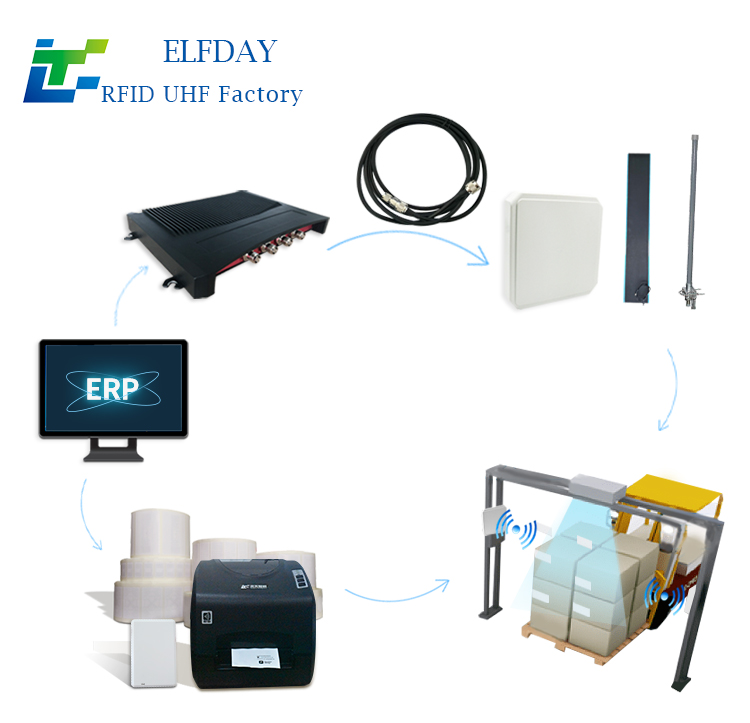
A typical UHF RFID system may include:
UHF RFID tag → RFID antenna → RFID reader → Software
This makes UHF RFID more suitable for automated industrial and logistics applications where dedicated infrastructure is acceptable.
RFID vs NFC: How Are They Used?
The two technologies often serve different workflows.
RFID Applications
RFID is commonly used for:
-
Inventory tracking
-
Warehouse management
-
Asset tracking
-
Supply chain visibility
-
Pallet tracking
-
Retail inventory
-
Manufacturing
-
Tool tracking
-
Equipment identification
These applications often involve identifying large numbers of physical assets.
NFC Applications
NFC is commonly used for:
-
Contactless payments
-
Access control
-
Product information
-
Digital experiences
-
Device pairing
-
Smart labels
-
Authentication
-
Marketing interactions
These applications often involve a person intentionally interacting with a tag or device.
RFID vs NFC for Inventory Tracking
RFID is often more suitable for high-volume inventory tracking.
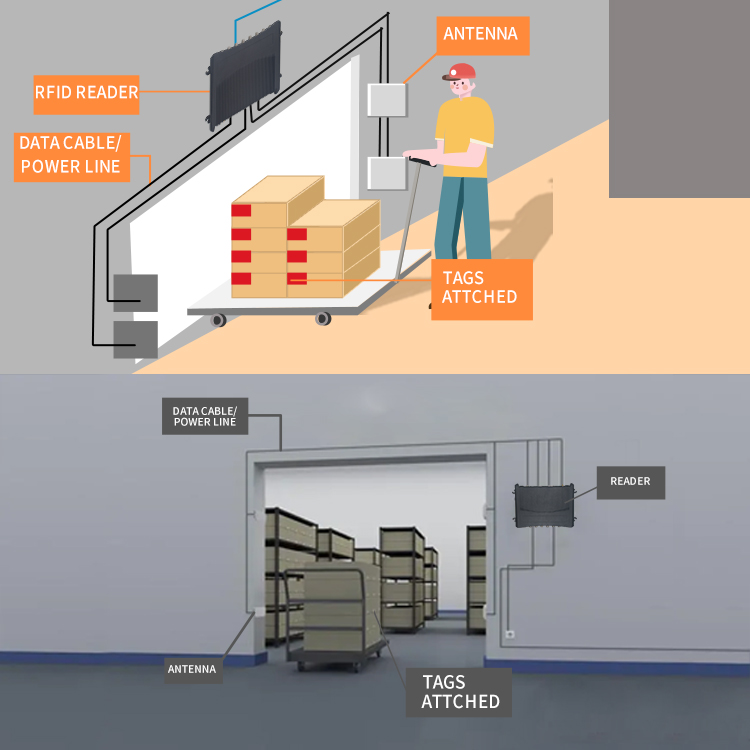
A UHF RFID reader can potentially identify multiple tagged items during the same reading process.
For example:
Tagged cartons → Reading zone → RFID reader → Multiple item IDs captured
NFC is generally designed around close-range interaction.
A worker would typically need to bring an NFC-enabled device close to each tag.
This makes NFC useful for individual item interaction but less suited to large-scale automated inventory counting.
RFID vs NFC for Asset Tracking
Both technologies can identify assets, but the tracking workflow can be very different.
NFC Asset Identification
A worker approaches an asset and taps an NFC-enabled smartphone against the tag.
Asset → NFC tag → Smartphone → Asset information
This can be useful when intentional human interaction is part of the process.
RFID Asset Tracking
A reader can potentially detect tagged assets automatically.
Asset → RFID tag → Reader → Tracking system
This can support automated location, movement, check-in, or check-out workflows.
For example, RFID can be used to detect tagged tools entering or leaving a designated area without requiring workers to scan each item individually.
RFID vs NFC for Product Tracking
Both technologies can be attached to products.
NFC can be useful when the customer or employee needs to interact directly with the product.
For example:
Tap product → Smartphone reads NFC tag → Product information opens
RFID can be useful when the main goal is automated product identification throughout a supply chain.
For example:
Product → RFID reader → Inventory system
Some products can use both technologies.
An NFC tag can provide smartphone interaction while another RFID technology supports warehouse or logistics tracking.
RFID vs NFC for Data Transfer
NFC is designed not only for identification but also for short-range communication and data exchange.
An NFC tag can provide information to a compatible device when brought close to it.
RFID applications are often more focused on identification and tracking, although RFID tags can also store data depending on the technology and tag memory.
In a typical tracking application:
RFID identifier → Database → Product record
This means the tag does not necessarily need to store a large amount of information.
RFID vs NFC: Passive Tags
Both RFID and NFC can use passive tags.
A passive tag does not require its own battery for basic communication.
Instead, the reader provides the energy needed for the tag to respond.
This can enable:
-
Small tag designs
-
Long service life
-
Low maintenance
-
Simple installation
However, the way energy is transferred and the practical operating distance differ significantly between NFC and different RFID systems.
RFID vs NFC on Metal
Metal can affect RFID and NFC performance because conductive materials interact with electromagnetic fields.
A conventional tag may experience reduced performance when placed directly on metal.
For industrial applications, specialized on-metal RFID tags can be used.
NFC tags can also require suitable design or spacing when installed on metal surfaces.
Therefore, if the application involves:
-
Metal equipment
-
Steel cabinets
-
Machinery
-
Metal containers
-
Tools
the tag should be tested on the actual mounting surface.
RFID vs NFC Near Liquids
Liquids can also affect RF performance, particularly at certain frequencies.
This is relevant when tags are attached to:
-
Bottles
-
Beverage containers
-
Cosmetics
-
Pharmaceutical products
-
Liquid-filled packaging
UHF RFID can experience changes in read performance around liquids, especially water-rich contents.
NFC and HF RFID also require appropriate tag design when used with challenging materials.
In either case, the finished product should be tested rather than assuming that the tag will perform the same way as it does in free air.
RFID vs NFC: Cost
The cost comparison depends heavily on the application.
NFC tags can be inexpensive for simple close-range applications, especially when the existing smartphone ecosystem is used as the reader.
RFID systems can require additional infrastructure, particularly for UHF applications.
Costs may include:
-
RFID tags
-
Readers
-
Antennas
-
Software
-
Integration
-
Installation
However, the cost of the technology should be evaluated together with the operational workflow.
A more expensive RFID system may reduce manual scanning in a high-volume environment, while an NFC solution may be sufficient when users only need to tap individual items.
Which Is Better for Warehouse Tracking?
For warehouse environments, RFID and NFC typically serve different purposes.
RFID
Suitable for workflows involving:
-
Large numbers of items
-
Automated reading
-
Receiving
-
Shipping
-
Inventory counting
-
Pallet tracking
-
Carton identification
NFC
More suitable for:
-
Individual item interaction
-
Worker instructions
-
Equipment information
-
Smartphone-based identification
-
Close-range authentication
If the main goal is automatically identifying many products as they move through a warehouse, UHF RFID may be a more appropriate technology.
If the goal is allowing a worker to tap one item with a smartphone, NFC may provide a simpler workflow.
Which Is Better for Consumer Interaction?
NFC is particularly useful when consumers need to interact directly with a product.
A customer can bring an NFC-enabled smartphone close to a tag and receive information.
Possible applications include:
-
Product details
-
Digital manuals
-
Authentication
-
Product registration
-
Digital experiences
-
After-sales information
RFID can also identify products, but its typical strength is automated identification rather than smartphone-based consumer interaction.
Can RFID and NFC Be Used Together?
Yes. RFID and NFC can complement each other.
For example, a product could use:
UHF RFID → Warehouse and supply chain tracking
NFC → Customer smartphone interaction
This creates two different interaction layers.
The RFID system can identify the product automatically during logistics processes, while NFC provides a convenient way for a person to access product information.
This approach can be useful when both operational tracking and direct user interaction are important.
RFID Tags vs NFC Tags: Which Should You Choose?
The answer depends on the workflow.
Choose NFC when you need:
-
Very short-range interaction
-
Smartphone compatibility
-
Individual item interaction
-
Tap-based communication
-
Customer engagement
-
Simple close-range identification
Consider RFID when you need:
-
Longer reading distances
-
Automated identification
-
Multiple-tag reading
-
Inventory tracking
-
Warehouse automation
-
Asset tracking
-
Logistics visibility
For some applications, there is no need to choose only one.
NFC can handle human interaction, while RFID can handle automated tracking.
RFID vs NFC Decision Guide
| Requirement | RFID | NFC |
| Smartphone interaction | △ | ✓ |
| Very short-range communication | ✓ | ✓ |
| Long-range identification | ✓* | ✗ |
| Multiple-tag reading | ✓* | Limited |
| Automated inventory | ✓ | ✗ |
| Product information via phone | △ | ✓ |
| Warehouse tracking | ✓ | △ |
| Asset tracking | ✓ | ✓ |
| Tap-to-interact applications | △ | ✓ |
| Dedicated readers | Often | Not always |
| Consumer interaction | △ | ✓ |
*Capabilities depend on the specific RFID frequency and system design.
Frequently Asked Questions
Are RFID and NFC the same thing?
No. NFC is a specific short-range communication technology closely related to 13.56 MHz HF RFID, while RFID is a broader family that includes LF, HF, and UHF technologies.
Can an NFC tag be read by an RFID reader?
It depends on the reader and RFID technology. NFC operates at 13.56 MHz and uses standards that are not automatically compatible with every RFID reader.
Can RFID tags work with smartphones?
Some RFID technologies can be supported by specialized smartphone hardware or accessories, but ordinary smartphones generally do not provide native UHF RFID reading. NFC is much more directly supported by modern smartphones.
Which has a longer range, RFID or NFC?
Many RFID systems, particularly UHF RFID, can operate over much greater distances than NFC. NFC is intentionally designed for close-range communication.
Is NFC better than RFID for product information?
NFC can be convenient when people need to tap a product with a smartphone to access information. RFID can be more suitable when products need to be automatically identified during logistics or inventory processes.
Is RFID better than NFC for inventory tracking?
RFID can support automated, longer-range, and multiple-item identification, making it suitable for many inventory workflows. NFC is generally more focused on close-range individual interactions.
Can RFID and NFC be used on the same product?
Yes. A product can use RFID for automated supply-chain tracking and NFC for smartphone-based customer or employee interaction.
RFID and NFC are related technologies, but they are designed for different types of communication and tracking.
NFC is optimized for short-range, intentional interactions, especially with smartphones and other NFC-enabled devices. RFID is a broader technology family that can support short-range identification as well as longer-range automated tracking, depending on the frequency and system design.
For warehouse inventory, logistics, asset tracking, and automated identification, RFID can provide capabilities that NFC is not primarily designed for. For smartphone interaction, tap-based communication, and individual product engagement, NFC can be a practical choice.
The key is to match the technology to the workflow rather than treating RFID and NFC as direct substitutes. In some applications, using both technologies together can provide automated tracking and convenient human interaction in the same product or asset.