



How Does Tag Placement Influence RFID Identification Accuracy?
RFID technology enables businesses to identify products, track assets, manage inventory, and automate workflows. However, even when the tags and readers are compatible, identification accuracy can vary significantly depending on where and how each RFID tag is installed.
A tag placed in an unsuitable position may be difficult to read, produce inconsistent results, or be detected by a reader outside the intended reading zone. In applications involving metal equipment, densely packed inventory, or moving items, tag placement can have a direct impact on operational reliability.
Understanding how tag placement influences RFID identification accuracy helps businesses improve read performance, reduce missed reads, and maintain more dependable asset records.
This guide explains the main factors affecting RFID tag placement and provides practical recommendations for different industrial and commercial applications.
1. Why RFID Tag Placement Matters
RFID systems use radio-frequency communication between tags and readers. The reader must transmit a suitable signal to the tag, and the tag must return a response that the reader can successfully detect.
The strength and reliability of this communication depend on several factors, including tag design, reader configuration, antenna characteristics, surrounding materials, and the physical position of the tag.
Poor placement can create several problems:
-
Missed reads: The reader fails to detect a tag during an expected reading event.
-
Inconsistent reads: A tag is detected in some positions but not others.
-
Unwanted reads: The system identifies tags outside the intended area.
-
Reduced reading efficiency: Employees or automated systems need additional attempts to identify assets.
-
Inaccurate tracking records: Missing or incorrectly associated read events affect inventory and asset-management data.
Correct tag placement cannot eliminate every RFID performance issue, but it can reduce avoidable problems and make system performance more predictable.
2. Tag Orientation Affects Reading Performance
The orientation of an RFID tag determines how its antenna is positioned relative to the reader antenna. Depending on the tag and antenna design, changes in orientation can influence the strength of the received signal.
This is particularly important when assets are moving, stored at different angles, or handled by different employees.
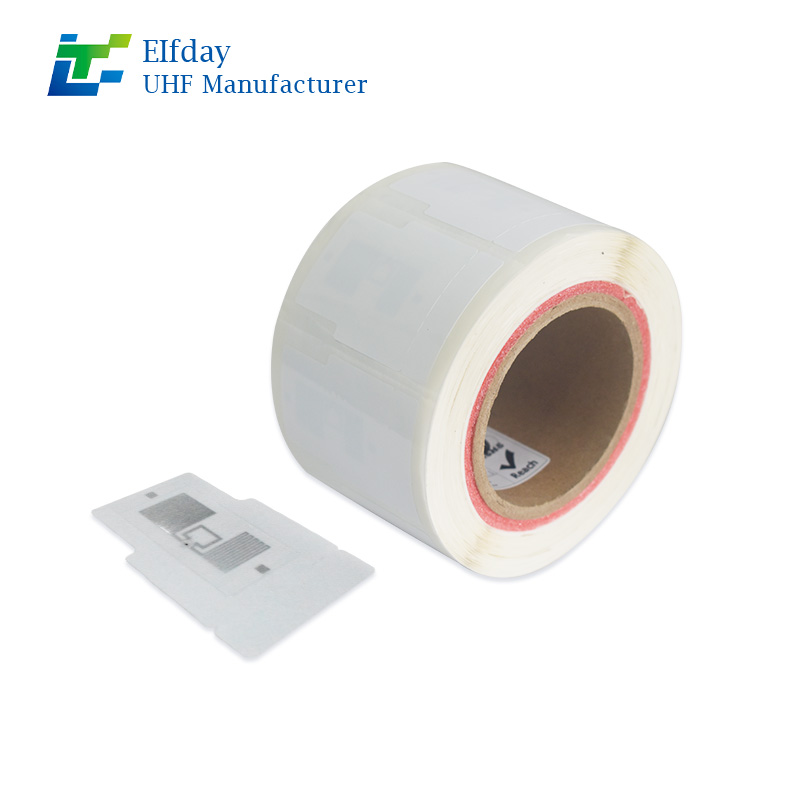
For example, a UHF RFID label attached to a carton may be read consistently when its antenna is well aligned with the reader antenna. If the carton rotates during handling, the same tag may become more difficult to identify.
How to Improve Tag Orientation
-
Standardize tag orientation across similar assets whenever practical.
-
Follow the tag manufacturer's recommended installation position.
-
Test tags at different angles using the actual reader and antenna configuration.
-
Consider the movement and rotation of items during normal operations.
-
Where orientation cannot be controlled, evaluate an antenna configuration that accommodates the expected range of tag positions.
Circularly polarized reader antennas can help accommodate varying tag orientations in some UHF applications. However, polarization alone does not guarantee consistent reads, and performance should be verified in the intended environment.
3. Metal Surfaces Can Interfere With Tag Performance
Metal is one of the most important placement considerations in industrial RFID applications.
When a conventional RFID tag is mounted directly on a metal surface, the metal can alter the electrical behavior of the tag antenna and interfere with communication. The result may be a shorter effective reading distance or inconsistent identification.
This issue can occur with:
-
Industrial machinery
-
Metal cabinets and equipment enclosures
-
Hand tools and metal components
-
Steel storage racks
-
Metal pallets and reusable containers
Recommended Placement Practices
For assets made of metal, consider an RFID tag specifically designed for on-metal mounting. These tags use constructions intended to operate on or near conductive surfaces.
If a standard tag must be used, follow the manufacturer's mounting recommendations. A spacer or alternative mounting position may help in some applications, but it should not be assumed to solve the problem without testing.
Also evaluate nearby metal structures. A tag mounted on a non-metallic object may still be affected by a metal surface immediately behind it or close to its antenna.
Practical tip: Test the tag on the actual asset rather than evaluating it only on a desk or in open space. The mounting surface can change RFID performance substantially.
4. Liquids and Moisture-Rich Materials Affect Placement Choices
Water and other liquid-rich materials can absorb or alter radio-frequency energy. This is particularly relevant to many UHF RFID applications.
If a tag is mounted directly against a liquid-filled container, placed behind a liquid-rich product, or positioned close to wet materials, its performance may differ from that of a tag tested in open air.
For example, a tag attached to the outer surface of a container filled with liquid may require a different placement strategy from a tag used on an empty container.
How to Reduce Placement-Related Problems
-
Test tags with the container or product in its normal operating state.
-
Compare alternative mounting positions where the asset design permits.
-
Avoid assuming that a tag will perform identically when the container is empty and full.
-
Consult the tag manufacturer about suitable designs for liquid-rich environments.
-
Validate reading performance with representative contents and packaging.
The best position depends on the tag frequency, antenna design, container materials, and surrounding environment. Testing is more reliable than applying a single placement rule to every application.
5. Distance From the Reader and Antenna Position
A tag must be within the effective reading area of the RFID system. However, being physically close to a reader does not always guarantee better performance.
Antenna radiation patterns, polarization, nearby materials, reflections, and tag orientation all affect communication. Some locations within a read zone may perform better than others.
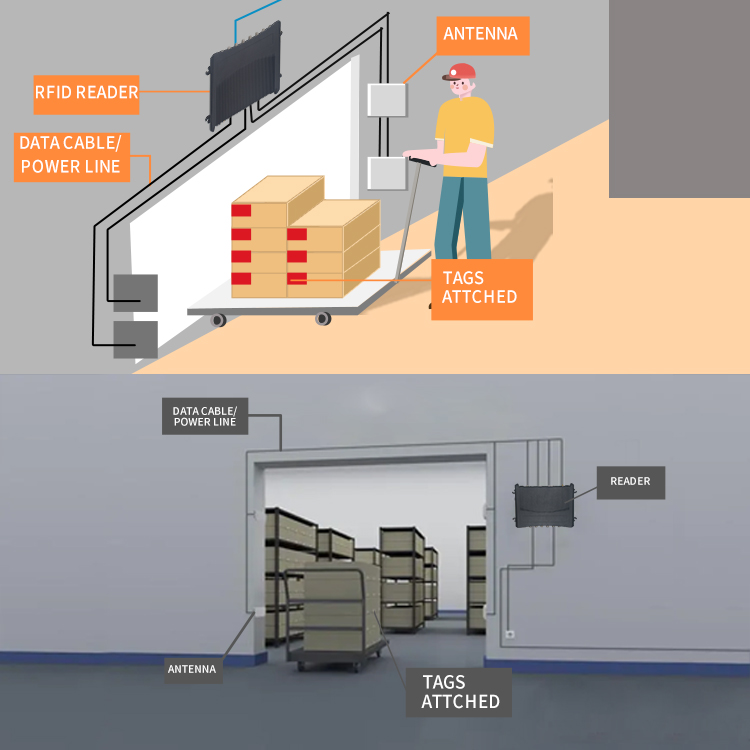
In a warehouse, for example, tags near the center of a properly designed reading zone may be detected consistently, while tags positioned behind a shelf support or at the edge of the zone may be missed.
Placement Recommendations
-
Identify the expected reading zone before attaching tags to assets.
-
Position tags where the installed antennas can communicate with them reliably.
-
Avoid mounting tags in locations routinely hidden by metal structures or other objects.
-
Test reading performance at the edges of the zone, not just at its center.
-
Consider antenna height, angle, and polarization during system design.
For moving items, make sure tags remain within the effective reading area long enough for the system to identify them.
If unwanted reads from adjacent areas are a concern, the solution may also require adjustments to antenna direction, reader power, or application-level filtering. Tag placement is one part of controlling the reading zone, not the only factor.
6. Tag Placement on Moving Assets
In manufacturing facilities and distribution centers, RFID tags are often installed on cartons, pallets, tools, and containers that move continuously through operational areas.
Movement changes the tag's position relative to the reader. Items may rotate, tilt, overlap, or pass through the reading zone at different speeds.
A tag that works well when an item is stationary may therefore produce less consistent results during movement.
How to Improve Identification Accuracy
-
Choose a consistent tag location on each asset type.
-
Consider the direction in which items move through the reading zone.
-
Avoid positions that are frequently covered by other objects.
-
Test the tag at normal and peak operating speeds.
-
Include different item orientations and spacing in the test procedure.
-
Confirm that the reader can detect the tag within the available reading time.
For pallets and large containers, the best tag location may depend on how the load is wrapped, stacked, transported, and approached by the reader antennas.
For small tools or components, consider whether the tag will remain exposed and securely attached during handling.
7. Tag Placement in High-Density Storage Areas
When many tagged items are stored close together, their physical arrangement can influence RFID performance.
Dense inventory may include cartons on shelves, tools in storage cabinets, or reusable containers stacked in a limited space. Tags may face different directions or be surrounded by materials that affect RF propagation.
In some configurations, nearby tags can also change the behavior of individual tag antennas, particularly when tags are positioned very close together or mounted against unsuitable materials.
Practical Recommendations
-
Standardize tag positions across similar products or containers.
-
Test tags in the actual storage configuration.
-
Check performance when shelves and containers are fully loaded.
-
Avoid assuming that results from a single isolated tag will represent a dense inventory environment.
-
Adjust antenna placement and reader settings if the intended reading zone is not covered adequately.
If the system needs to identify individual items in a crowded storage area, test with the expected number of tags and the actual reader configuration. Placement improvements should be evaluated alongside inventory settings and application requirements.
8. Tag Size, Shape, and Mounting Surface
RFID tags are available in different sizes, shapes, materials, and constructions. The physical design affects where a tag can be installed and how it performs in its intended environment.
A small tag may fit a narrow tool or compact component, while a larger tag may provide more space for an antenna design suited to a particular application. However, size alone does not determine reading performance.
When selecting a tag, consider:
-
The available mounting area
-
The shape and curvature of the asset
-
The material beneath the tag
-
Required attachment strength
-
Exposure to impact, abrasion, and cleaning
-
Reader frequency and required reading distance
A tag attached to a curved surface may not sit securely if its construction is intended for flat mounting. Poor adhesion or an unstable mounting position can also cause the tag to shift over time.
Choose a design that fits the asset and its operating conditions, then verify performance after installation.
9. Attachment Method Influences Long-Term Accuracy
Even a well-designed RFID tag can become unreliable if it is not attached securely.
Adhesive failure, vibration, repeated impact, or improper installation can change a tag's position or damage its antenna. These problems may appear gradually, making it difficult to identify the original cause of inconsistent reads.
Common mounting methods include:
-
Industrial adhesive labels
-
Screws or mechanical fasteners
-
Rivets
-
Cable ties and mounting brackets
-
Integrated or embedded tag designs
The appropriate method depends on the asset material, expected service life, environmental exposure, and whether the tag must be replaceable.
For adhesive tags, surface cleanliness, texture, temperature, and compatibility with the adhesive are important. For mechanically mounted tags, confirm that the attachment method does not damage the tag or compromise the asset.
Include attachment checks in routine maintenance for applications where reliable identification is essential.
10. Standardize Tag Placement Across the Organization
Inconsistent installation practices can create avoidable differences in RFID performance.
For example, if several employees attach tags to the same type of container but choose different positions each time, the reader may detect some containers more reliably than others. Troubleshooting also becomes more difficult because the tag location is not consistent.
A standard placement procedure should specify:
-
Approved tag model and size
-
Exact mounting area or acceptable placement range
-
Required orientation, where applicable
-
Minimum clearance from unsuitable materials, if specified by the manufacturer
-
Approved attachment method
-
Surface preparation and installation instructions
-
Inspection criteria for damaged or displaced tags
Use photographs or simple installation diagrams to help employees follow the same procedure.
For assets with different shapes or materials, define separate placement standards rather than forcing every asset to use one universal location.
11. Test Tag Placement Before Large-Scale Deployment
The most reliable way to determine whether a tag position is suitable is to test it under realistic operating conditions.
A structured placement test can help identify the best position before purchasing and installing tags in large quantities.
Recommended Testing Process
Step 1: Select representative assets.
Include typical assets as well as difficult cases, such as metal equipment, curved containers, or tightly packed inventory.
Step 2: Test alternative mounting positions.
Compare practical locations and orientations while keeping the reader configuration consistent.
Step 3: Reproduce actual operating conditions.
Include normal movement, expected tag density, typical contents, and surrounding equipment.
Step 4: Record successful and missed reads.
Compare detected tag identifiers against a known list of expected identifiers.
Step 5: Evaluate unwanted reads.
Confirm that improving detection does not cause the system to identify too many tags outside the intended zone.
Step 6: Document the preferred installation method.
Record the selected position, orientation, tag model, reader configuration, and test conditions.
For critical applications, repeat the test across multiple runs and representative assets. A single successful scan is not sufficient evidence that a placement method will remain reliable in daily operation.
12. Measure RFID Identification Accuracy
Businesses can use repeatable measurements to compare different tag positions and determine whether an installation change improves performance.
One useful metric is the read success rate:
Read success rate = unique expected tags successfully detected ÷ total unique expected tags × 100%
For example, if 190 out of 200 expected tags are detected during a defined test, the observed read success rate is 95%.
This result applies only to that test configuration. It does not guarantee the same performance at other distances, speeds, orientations, or tag densities.
It is also important to distinguish tag detection from complete tracking accuracy. A reader may successfully identify a tag, while software may still assign an incorrect location or process the event incorrectly.
For a more complete evaluation, track:
-
Missed reads
-
Unwanted reads from outside the intended zone
-
Duplicate events
-
Read performance across different asset types
-
Detection time for moving items
-
Accuracy of the final asset record
These measurements help teams assess both the physical RFID installation and the complete tracking workflow.
Tag placement plays an important role in RFID identification accuracy because it affects antenna orientation, proximity to interfering materials, reading-zone coverage, and consistency across assets.
To improve performance, choose a tag suitable for the asset's material, standardize its mounting position, evaluate nearby metal and liquid-rich materials, and test the complete system under realistic operating conditions.
The best placement is not necessarily the one closest to the reader. It is the position that supports reliable identification within the intended read zone while remaining practical and secure throughout normal use.
Looking for RFID tags for industrial identification and tracking? EFLDAY provides RFID tag and reader solutions for a range of asset identification, inventory, and industrial tracking applications. Share your asset material, mounting requirements, reading distance, and operating environment with our team to discuss a suitable solution.