




How Can RFID Tag Placement Simplify Asset Identification?
RFID technology helps businesses identify, track, and manage assets without requiring direct visual contact with every tag. However, the effectiveness of an RFID asset tracking system depends on more than the tag and reader specifications. Where an RFID tag is placed can also influence how easily an asset can be identified during daily operations.
Poor tag placement may make scanning inconvenient, create inconsistent read results, or require employees to reposition assets before identification. In contrast, a well-planned placement strategy can make asset identification more straightforward, improve inventory workflows, and simplify routine inspections.
For businesses managing tools, equipment, containers, and other valuable assets, understanding the relationship between RFID tag placement and identification efficiency is an important part of system planning.
1. Place RFID Tags Where They Are Easy to Access
An RFID tag should be installed in a location that supports convenient identification during normal operations.
If employees need to move equipment, open compartments, or turn assets around to locate a tag, routine identification can become unnecessarily complicated.
When selecting a mounting position, consider:
-
Whether employees can easily access the tag.
-
Whether the tag can be scanned without moving the asset.
-
Whether the position remains consistent across similar assets.
-
Whether the tag is protected from accidental impact.
-
Whether the location is suitable for the intended reader and antenna arrangement.
For example, frequently used tools may benefit from a consistent tag location that employees can quickly identify. Storage containers can use a designated mounting area that remains accessible during receiving, storage, and dispatch.
A convenient position makes RFID identification easier to incorporate into everyday work.
2. Use Consistent Placement Across Similar Assets
Consistency is especially important when a business manages large numbers of similar assets.
If RFID tags are installed in different positions on otherwise identical items, employees may need to adjust their scanning approach for each asset. This can make identification less predictable and complicate automated scanning workflows.
A standardized placement rule can help solve this problem.
For example:
-
Attach tags to the same side of similar storage containers.
-
Use a designated mounting area on standardized tools.
-
Keep tag orientation consistent across equipment models where practical.
-
Define approved tag positions for different asset categories.
Standardized placement also makes it easier to train employees and document installation procedures.
For organizations with multiple facilities, a consistent tagging standard can support more uniform asset identification practices across locations.
3. Avoid Placement That Creates RFID Signal Interference
A tag may be easy to access but difficult to read if it is installed in an unsuitable location.
Nearby materials and components can influence RFID communication. Metal surfaces, liquids, electronic components, and other surrounding objects may affect performance depending on the tag design and operating frequency.
To reduce placement-related problems:
-
Avoid mounting standard RFID tags directly on metal unless they are designed for that application.
-
Check whether nearby metal structures interfere with the intended communication path.
-
Consider the position of batteries, motors, and other internal components.
-
Test different tag orientations when the available mounting area is restricted.
-
Confirm performance after the asset is fully assembled.
For metal equipment, an on-metal RFID tag may be a more appropriate choice than a conventional label.
The goal is not simply to find an accessible position, but to find a position that supports both convenient access and reliable identification.
4. Make Tags Easy to Locate During Manual Scanning
Although RFID does not require employees to visually align a reader with a barcode, the physical location of the tag still matters.
When using handheld RFID readers, employees may need to scan individual assets or inspect specific items. A predictable tag location can make this process easier.
For example, a maintenance team can follow a standard scanning procedure if every tool has its RFID tag installed in a familiar location.
This approach can help:
-
Reduce time spent searching for tag locations.
-
Simplify employee training.
-
Make manual verification more straightforward.
-
Support consistent inspection procedures.
-
Reduce confusion when multiple asset types are involved.
A clear placement standard is particularly useful when RFID scanning is performed by different employees or across multiple shifts.
5. Consider Tag Placement in Relation to Reader and Antenna Coverage
RFID tag placement should be planned together with the reader and antenna configuration.
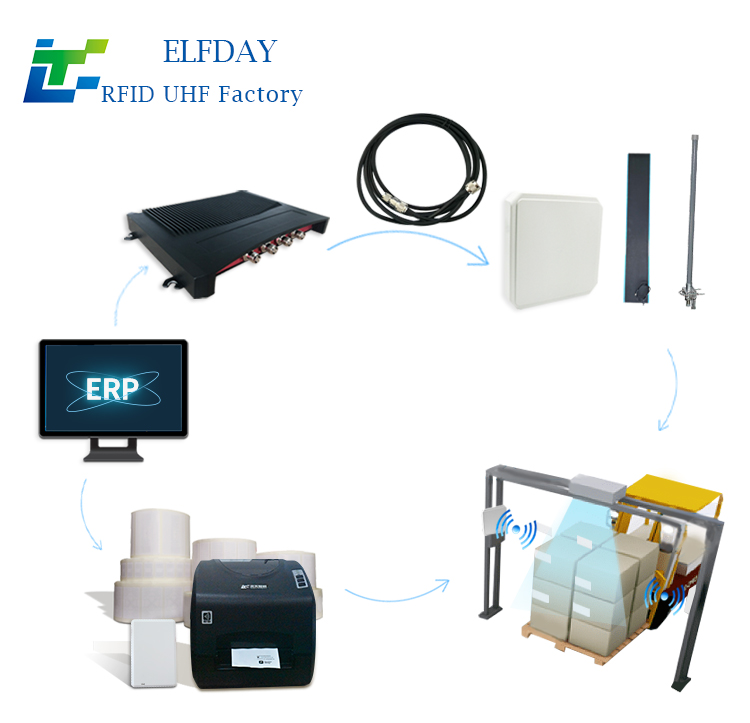
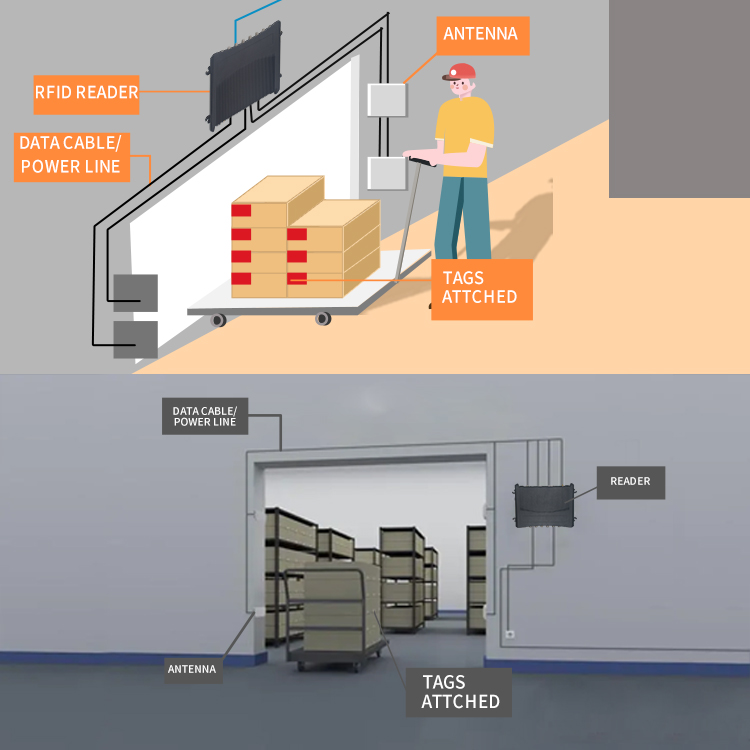
In fixed RFID systems, antennas are often installed at entry points, storage areas, workstations, or designated identification zones. The position of the tag can influence whether an asset passes through the intended read area in a suitable orientation.
For example, an asset tracking system may use fixed antennas to identify items moving through a warehouse entrance. If tags are mounted on inconsistent sides or are frequently blocked by other objects, identification may become less predictable.
When planning placement, evaluate:
-
The direction in which assets normally move.
-
The location and orientation of reader antennas.
-
The expected distance between tags and antennas.
-
Potential obstructions along the communication path.
-
Whether assets may overlap or be stacked during scanning.
For handheld applications, consider how employees naturally hold or approach the asset.
Testing tag placement with the actual reader and antenna setup helps confirm whether the design supports the intended workflow.

6. Avoid Positions That Are Easily Damaged or Covered
A tag that is frequently scratched, covered, or detached can create unnecessary identification problems.
The selected position should account for how an asset is handled, stored, transported, and maintained.
For example:
-
Tags on tools should avoid areas exposed to repeated friction or impact.
-
Tags on containers should not be placed where labels or packaging regularly cover them.
-
Tags on mobile equipment should be protected from routine contact and cleaning activities.
-
Tags on outdoor assets should be positioned with environmental exposure in mind.
Protective housings, recessed mounting areas, or alternative tag constructions may be useful when the normal mounting location is exposed to physical damage.
However, protective materials and mounting structures should also be evaluated for their effect on RFID performance.
7. Use Placement Standards to Simplify Asset Inventory
Consistent RFID tag placement can make asset inventory procedures easier to organize.
When tags are installed according to a defined standard, employees can follow repeatable scanning routes and identification procedures.
For example, a warehouse team may scan storage containers in a consistent sequence, while a maintenance team may inspect equipment according to designated tag locations.
A standardized approach can support:
-
More predictable scanning procedures.
-
Easier identification of missing or misplaced assets.
-
Simpler employee training.
-
More consistent asset inspection.
-
Better coordination between physical assets and digital records.
RFID placement alone does not guarantee inventory accuracy. The reader configuration, tag performance, software, and operating procedures also matter. However, consistent placement can remove one common source of operational complexity.
8. Test Placement Before Applying It to Every Asset
Before deploying RFID tags across a large asset population, evaluate the proposed placement strategy with a representative group of assets.
A pilot test can reveal practical problems that may not be obvious during design.
A useful testing process includes:
-
Select representative assets from each major category.
-
Identify potential mounting positions.
-
Install tags using the intended attachment method.
-
Test identification with the planned RFID readers and antennas.
-
Repeat scans under normal operating conditions.
-
Check whether tag locations remain accessible during routine handling.
-
Document the preferred positions for each asset category.
If the system uses fixed readers, test assets moving through the actual read zone. If handheld readers are used, test normal employee scanning procedures.
The results can be used to establish a placement standard before full deployment.
9. Combine Placement Rules With Asset Data Management
Physical tag placement is only one part of an effective asset identification process.
Each RFID tag should also be associated with the correct asset record in the management system.
A practical implementation should define:
-
A unique identification number for each tagged asset.
-
A consistent relationship between the RFID ID and the asset record.
-
A standard installation location for each asset category.
-
Procedures for replacing damaged or missing tags.
-
Regular checks to confirm that tag data remains correctly associated with physical assets.
When physical placement standards and digital asset records are managed together, employees can identify assets more easily and maintain more consistent information.
RFID tag placement can simplify asset identification by making tags easier to access, keeping their positions consistent, reducing avoidable interference, and supporting the way employees and readers interact with assets.
The most effective placement strategy considers the asset's structure, operating environment, handling process, and RFID reader configuration. Rather than choosing tag locations independently, businesses should establish practical placement standards and validate them through real-world testing.
For organizations planning or improving an RFID asset tracking system, working with an experienced RFID supplier can help identify suitable tag designs and placement options for different asset types.
Looking for RFID tags for asset identification and tracking? EFLDAY can help evaluate your assets, mounting surfaces, and reader requirements to identify suitable RFID tag solutions.

