



How to Assess RFID Tag Reliability Over Repeated Use Cycles
RFID tags are widely used in logistics tracking, warehouse management, industrial automation, asset tracking, and reusable product identification. In many applications, RFID tags are exposed to repeated reading, writing, handling, installation, and environmental changes throughout their service life.
Over time, these repeated operations may affect tag performance, antenna integrity, chip connections, and physical durability.
Therefore, assessing RFID tag reliability over repeated use cycles is essential for manufacturers and quality control teams to ensure consistent identification performance, reduce maintenance costs, and extend product service life.
This article explains how to evaluate RFID tag reliability through practical testing methods and performance monitoring.
Identify the Key RFID Tag Reliability Indicators
Before conducting repeated-use testing, it is important to identify the main performance indicators.
These indicators help determine whether an RFID tag can maintain stable operation after extended use.
|
Reliability Indicator |
What to Evaluate |
Testing Purpose |
|
Read Rate |
Successful tag identification |
Verify consistent reading performance |
|
Read Range |
Maximum reading distance |
Identify changes in RF performance |
|
Read Sensitivity |
Minimum activation power |
Evaluate RF response stability |
|
Data Integrity |
Accuracy of stored information |
Detect data corruption |
|
Write Performance |
Successful data-writing operations |
Verify memory functionality |
|
Antenna Integrity |
Antenna and connection condition |
Identify electrical damage |
|
Physical Durability |
Housing, surface, and structural condition |
Evaluate resistance to repeated handling |
These indicators provide a foundation for comparing RFID tag performance before and after repeated use.
Establish a Repeated Use Cycle Test
A repeated use cycle test simulates the actual operating conditions of RFID tags in real applications.
A typical testing procedure includes:
-
Place the RFID tag within the reader's operating range.
-
Read the tag's identification information.
-
Write or update stored data when supported by the application.
-
Verify that the updated information is accurate.
-
Remove the tag from the reading area.
-
Repeat the operation according to the planned test cycles.
To evaluate long-term reliability, perform inspections at different cycle intervals.
|
Test Stage |
Recommended Cycle Count |
Testing Objective |
|
Initial Test |
0 cycles |
Establish baseline performance |
|
Early Test |
100 cycles |
Identify early performance changes |
|
Intermediate Test |
500 cycles |
Evaluate short-term stability |
|
Extended Test |
1,000 cycles |
Assess repeated-use performance |
|
Long-Term Test |
5,000 cycles |
Evaluate long-term durability |
|
Endurance Test |
10,000 cycles |
Assess extended operational reliability |
Note: These are suggested testing intervals rather than mandatory industry standards. Actual cycle counts should be determined according to the RFID tag design and application requirements.
Evaluate RF Performance After Repeated Use
RF performance is one of the most important factors in RFID tag reliability assessment.
Even if a tag maintains its physical appearance, repeated use may cause antenna damage, connection problems, or changes in RF characteristics.
Focus on the following testing areas:
Read Rate Testing
Check whether the RFID tag can be identified consistently during repeated scanning operations.
A declining read rate may indicate antenna damage, chip connection problems, or changes in the surrounding environment.
Read Range Testing
Measure the maximum reading distance under consistent testing conditions.
Compare the reading distance at different cycle intervals to identify potential RF performance degradation.
Read Sensitivity Testing
Evaluate whether the RFID tag can still respond reliably when the reader's transmitted power is reduced.
Changes in activation sensitivity may indicate deterioration in antenna performance or electrical connections.
Data Integrity Testing
Perform repeated read-and-write operations to verify that stored information remains accurate.
Check whether the tag can:
Store information correctly.
Retrieve stored data without errors.
Maintain previously written information.
Support repeated data updates when required.
It is important to distinguish between read endurance, write endurance, and long-term data retention. These are separate reliability characteristics and should be evaluated independently.
Conduct Mechanical Durability Tests
Mechanical durability is particularly important for reusable RFID tags that experience frequent handling, installation, removal, or physical contact.
Recommended mechanical tests include:
|
Test Type |
Testing Method |
Potential Failure |
|
Bending Test |
Repeatedly bend or flex the tag |
Antenna fracture |
|
Drop Test |
Drop the tag from specified heights |
Housing or chip damage |
|
Impact Test |
Apply controlled mechanical impacts |
Internal connection failure |
|
Abrasion Test |
Repeatedly rub the tag against surfaces |
Surface damage |
|
Attachment Test |
Repeatedly install and remove the tag |
Mounting or adhesive failure |
|
Compression Test |
Apply repeated pressure |
Structural deformation |
Different RFID applications require different mechanical testing priorities.
For example:
Warehouse RFID tags: Focus on impact, vibration, abrasion, and compression resistance.
Laundry RFID tags: Focus on repeated washing, drying, squeezing, and bending.
Logistics RFID tags: Focus on handling, dropping, and attachment durability.
Industrial RFID tags: Focus on mechanical stress, chemical exposure, and temperature resistance.
These tests help identify weaknesses that may not appear during ordinary reading operations.
Perform Environmental Reliability Testing
RFID tags often operate in environments involving temperature changes, humidity, moisture, chemicals, and ultraviolet exposure.
Environmental testing helps determine whether repeated exposure affects tag performance and structural integrity.
|
Environmental Test |
Test Conditions |
Evaluation Focus |
|
High Temperature |
Exposure to elevated temperatures |
Material deformation and chip performance |
|
Low Temperature |
Exposure to low temperatures |
Material brittleness and RF stability |
|
Temperature Cycling |
Alternating hot and cold conditions |
Thermal fatigue |
|
Humidity Test |
High-humidity exposure |
Moisture penetration and corrosion |
|
Waterproof Test |
Water spraying or immersion |
Housing and sealing integrity |
|
Chemical Resistance |
Exposure to application-specific chemicals |
Material and antenna degradation |
|
UV Resistance |
Prolonged ultraviolet exposure |
Housing aging and surface deterioration |
For more reliable results, evaluate RF performance and physical condition both before and after environmental exposure.
The testing conditions should reflect the actual working environment rather than relying on unnecessarily severe conditions.

Monitor RFID Tag Performance Degradation
After completing repeated-use and environmental tests, compare the results across different testing intervals.
The following table illustrates how RFID tag performance can be recorded during long-term testing.
The figures below are hypothetical examples, not actual product test results.
|
Test Cycles |
Read Rate |
Read Range |
Physical Condition |
|
0 |
100% |
8.0 m |
Normal |
|
100 |
100% |
7.9 m |
Normal |
|
500 |
99% |
7.8 m |
Normal |
|
1,000 |
99% |
7.6 m |
Minor wear |
|
5,000 |
97% |
7.4 m |
Minor wear |
|
10,000 |
95% |
7.0 m |
Visible wear |
Illustrative read range changes across different testing intervals.
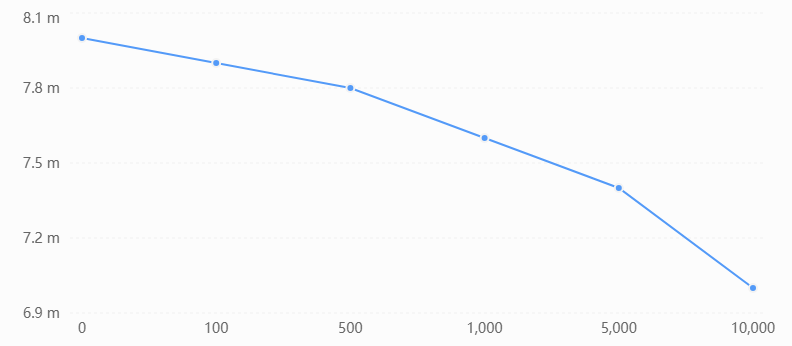
When analyzing the results, consider the following questions:
Does the tag maintain a stable read rate?
Is the reading distance consistent with the original specifications?
Are there signs of antenna or chip connection damage?
Does the tag experience gradual or sudden performance degradation?
Can the tag continue meeting the requirements of its intended application?
Continuous monitoring makes it easier to identify potential reliability problems before they cause operational failures.
Establish RFID Tag Reliability Acceptance Criteria
Before testing begins, manufacturers should establish clear acceptance criteria based on product specifications and application requirements.
For example, an internal quality control standard may include the following requirements:
|
Evaluation Item |
Example Acceptance Criteria |
|
Read Success Rate |
≥ 99% |
|
Read Range Retention |
≥ 90% of initial performance |
|
Data Integrity |
No data corruption |
|
Antenna Integrity |
No electrical damage |
|
Physical Structure |
No cracks or significant deformation |
|
Environmental Performance |
Meets specified operating requirements |
These are illustrative engineering targets, not universal RFID industry requirements.
For standardized performance evaluation, manufacturers can also refer to:
ISO/IEC 18046-3: RFID tag performance test methods.
ISO/IEC 18000-63: UHF RFID air interface requirements.
ISO/IEC TR 24729-1: Guidance on RFID environmental considerations.
The appropriate testing standards depend on the RFID technology, tag type, and intended application.
Use Statistical Analysis to Evaluate Reliability
Testing only one or two RFID tags is generally insufficient to establish product reliability.
A more reliable evaluation should include multiple samples from different production batches.
Recommended practices include:
-
Select representative samples from production batches.
-
Record the initial performance of every sample.
-
Conduct repeated-use tests under consistent conditions.
-
Record individual tag failures at each testing interval.
-
Compare read performance across different samples.
-
Identify recurring failure modes.
-
Evaluate differences between production batches.
For an initial comparative evaluation, manufacturers may consider testing at least 30 samples. Larger sample sizes are recommended when stronger statistical confidence is required.
Common failure modes worth documenting include:
Antenna breakage.
Chip detachment.
Damaged electrical connections.
Housing cracks.
Moisture penetration.
Reduced reading sensitivity.
Memory or data-writing failures.
Statistical records help manufacturers identify product weaknesses and improve RFID tag design and manufacturing processes.
RFID Tag Reliability Testing Checklist
A standardized testing checklist helps quality control teams maintain consistent procedures and documentation.
Testing checklist
0/10 completed
Record initial RFID performance and physical condition
Select representative samples from production batches
Establish consistent reader and antenna testing conditions
Perform repeated read/write operations
Measure read rate and read range at scheduled intervals
Conduct mechanical durability tests
Perform application-specific environmental tests
Inspect antenna, chip connections, and housing
Record failure rates and performance degradation
Prepare final reliability evaluation reports
Assessing RFID tag reliability over repeated use cycles requires a comprehensive evaluation of RF performance, mechanical durability, environmental resistance, and long-term operational stability.
By conducting structured cycle testing and regularly monitoring performance changes, RFID manufacturers can identify potential failure points, improve product quality, and extend the service life of reusable RFID tags.
For businesses using RFID technology in logistics, warehousing, industrial automation, and asset tracking, reliable tags help maintain accurate identification and consistent system operation.
Ultimately, RFID tag reliability is not determined only by how many times a tag can be used, but by how consistently it maintains its performance throughout its expected service life.