



Reusable Tote Box RFID Tags: Improve Cycle Tracking and Management
Reusable tote boxes play an important role in modern warehouses, manufacturing facilities, distribution centers, and supply chains. These containers are repeatedly used to transport, store, and distribute products between different locations. However, when businesses manage thousands of reusable tote boxes, tracking their movements, usage cycles, and return status can become a major operational challenge.
Traditional tracking methods, such as handwritten records, barcode labels, and manual inventory checks, often make it difficult to maintain accurate records of reusable containers. Businesses may lose track of tote boxes, experience delayed returns, or struggle to determine how many times each container has been used.
Reusable tote box RFID tags provide an automated identification solution that helps businesses track container movements, record usage cycles, monitor return status, and improve reusable asset management.
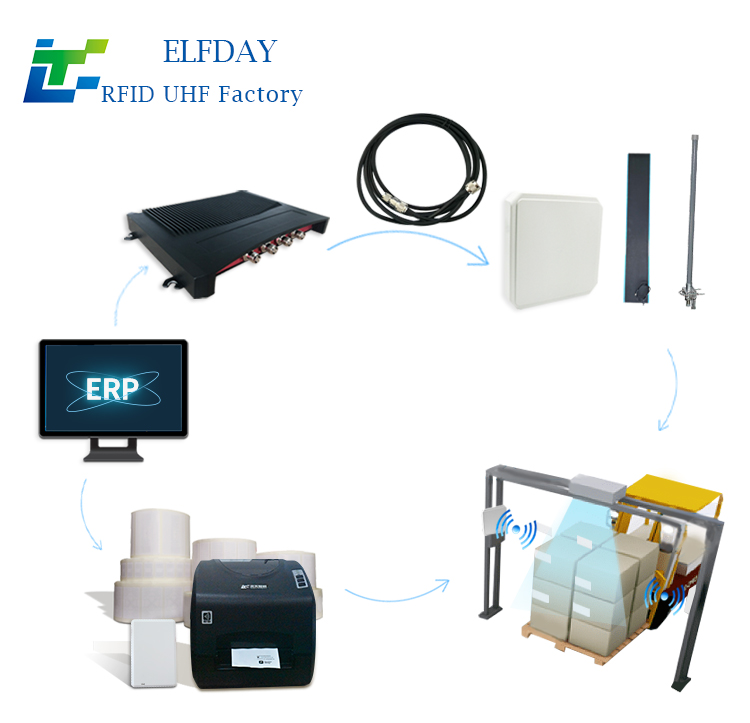
By attaching durable RFID tags to plastic tote boxes and integrating RFID readers with a management system, companies can create a more efficient and traceable container circulation process.
What Are Reusable Tote Box RFID Tags?
Reusable tote box RFID tags are electronic identification tags attached to reusable plastic containers, storage bins, transport boxes, and other returnable packaging assets.
Each RFID tag contains a microchip and antenna that communicate wirelessly with RFID readers. The tag stores or transmits a unique identification number, allowing the corresponding tote box to be recognized throughout its circulation process.
Unlike traditional barcode labels, RFID tags do not require direct visual scanning. Multiple tagged containers can be identified within the effective reading range of an RFID reader.
For reusable tote box applications, passive UHF RFID tags are commonly used because they support fast identification, bulk reading, and integration with warehouse and logistics systems.
Each tote box can be assigned a unique RFID identification number associated with information such as:
Tote box ID or asset number
Container type and dimensions
Manufacturing date
Owner or department
Current location
Usage cycle count
Last recorded movement
Return status
Maintenance and damage records
This information allows businesses to manage each reusable container as an individually identifiable asset.
Why Is Cycle Tracking Important for Reusable Tote Boxes?
Reusable tote boxes are designed to move through repeated transportation and handling cycles.
A typical circulation process may involve a warehouse sending empty containers to a manufacturing facility, the facility loading products into the containers, and the containers returning to the warehouse after delivery.
Without an effective tracking system, businesses may encounter several problems.
Lost containers: Tote boxes may remain at customer locations, production facilities, or distribution centers without being properly recorded.
Delayed returns: Employees may not know which containers have been returned or which ones are overdue.
Unclear usage history: Businesses may have difficulty determining how many times each tote box has been used.
Poor asset utilization: Some containers may remain unused in storage while other departments experience shortages.
Unexpected replacement costs: Damaged or missing containers can increase packaging procurement expenses.
RFID cycle tracking helps address these problems by recording container identification and movement events throughout the circulation process.
How Do RFID Tags Track Reusable Tote Box Cycles?
The main function of an RFID-based tote box tracking system is to associate each container with a unique identification number and record its movement whenever it passes through designated RFID reading points.
Here is how the system typically works.
1. Assign a Unique RFID Identity to Each Tote Box
An RFID tag is installed on each reusable tote box.
The tag's unique EPC number is registered in the management system and associated with the container's basic information.
For example:
Tote Box ID: TB-000125
RFID EPC: E28068940000501234567890
Container Type: Plastic Storage Tote
Status: Available
Cycle Count: 0
Owner: Warehouse Department
Once registered, the RFID tag becomes the electronic identity of that container.
2. Record Outbound Container Movements
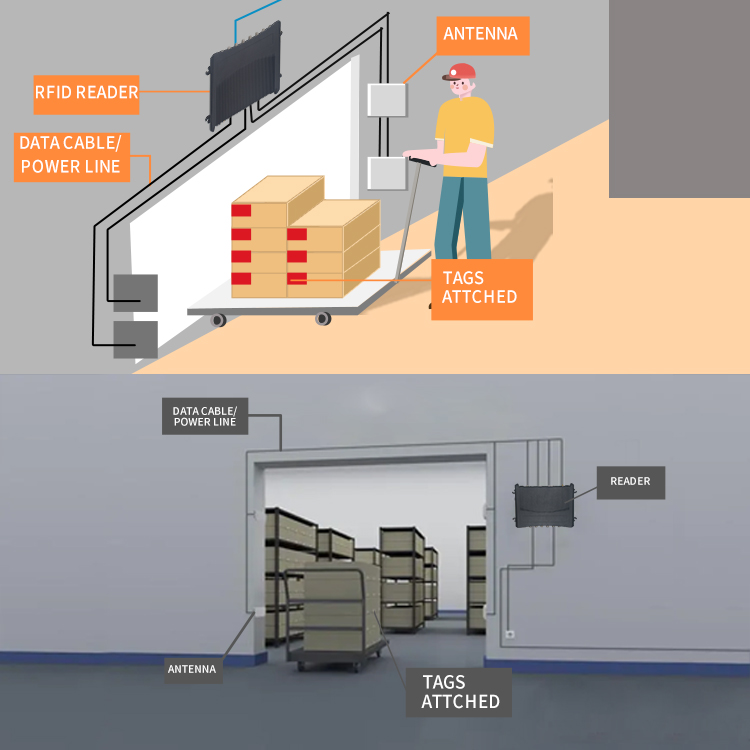
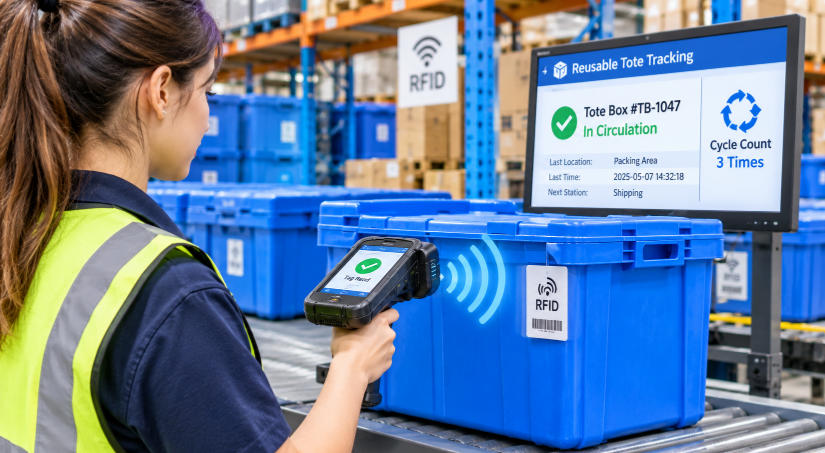
When a tote box leaves a warehouse or distribution center, it passes through an RFID reading point or is scanned using a handheld RFID reader.
The system identifies its RFID number and records the outbound movement.
Relevant information may include:
Tote box identification number
Departure location
Departure date and time
Destination
Associated shipment or order
Current circulation status
The system can then change the container status from Available to In Transit or Issued.
This helps businesses maintain records of which reusable containers have left each facility.
3. Track Container Returns
When reusable tote boxes return to a warehouse, an RFID reader identifies the tags and records the return event.
The system compares the returned container IDs with previously recorded outbound records.
This makes it easier to determine which containers have returned, which remain in circulation, and which are overdue.
If a container has not returned within the expected period, the system can flag it for further investigation.
4. Automatically Update Cycle Counts
One of the most useful functions of reusable tote box RFID tags is cycle tracking.
Each time a container completes a defined circulation cycle, the management system can update its usage count.
For example, a business may define one complete cycle as:
-
The tote box is issued from the warehouse.
-
It is transported to a production facility or customer.
-
It is used to store or transport products.
-
It returns to the designated warehouse.
-
The return is confirmed in the RFID system.
After the completed cycle is verified, the system increases the container's cycle count.
A tote box with 50 completed cycles can therefore be distinguished from one that has only completed 10 cycles.
The cycle-counting rules should be configured according to the company's actual circulation process to avoid counting incomplete or duplicate movements.
5. Monitor Container Condition and Maintenance
Reusable tote boxes are exposed to repeated loading, unloading, stacking, transportation, and handling.
Over time, some containers may become cracked, deformed, contaminated, or otherwise unsuitable for continued use.
By associating RFID identification records with inspection and maintenance information, businesses can maintain a more complete history of each container.
For example, the system may record:
Inspection date
Damage description
Maintenance records
Repair status
Replacement recommendations
Retirement date
This helps companies identify containers that require maintenance and make better decisions about asset replacement.
Key Applications of RFID Cycle Tracking for Reusable Tote Boxes
RFID technology can be used in different industries where reusable containers circulate between facilities.
1. Manufacturing and Production Facilities
Manufacturing companies often use reusable tote boxes to transport raw materials, components, and semi-finished products between production areas.
RFID tags help identify containers as they move between receiving areas, storage zones, production lines, and finished goods warehouses.
Businesses can use this information to monitor container availability and improve material handling efficiency.
2. Warehouse and Distribution Centers
Distribution centers frequently use reusable plastic totes for picking, sorting, order consolidation, and shipping.
With RFID tote box tracking, operators can identify multiple containers at designated reading points and update their location and circulation status.
This helps reduce manual identification work and improve container inventory visibility.
3. Retail Supply Chains
Retailers and suppliers often exchange reusable containers when delivering products to stores.
RFID tags can help businesses record when containers leave distribution centers, arrive at stores, and return to logistics facilities.
This supports returnable packaging management and helps reduce container losses.
4. Automotive Parts Logistics
Automotive manufacturers and suppliers use specialized returnable containers to transport components between production facilities.
RFID identification can help associate each container with its asset record, shipment information, and circulation history.
This is particularly useful when managing large numbers of reusable packaging assets across multiple locations.
5. Food and Beverage Distribution
Reusable plastic crates and tote boxes are widely used for transporting food and beverage products.
RFID tags suitable for the application can help track container movements and maintain identification records during repeated use.
For environments involving washing, moisture, or temperature changes, businesses should select tags with suitable environmental protection and test their performance under actual operating conditions.
What Type of RFID Tags Are Suitable for Reusable Plastic Tote Boxes?
Choosing the right RFID tag is important because reusable containers are exposed to repeated physical handling and different environmental conditions.
The tag should remain securely attached and provide consistent reading performance throughout the intended service life.
1. Industrial UHF RFID Tags
Industrial UHF RFID tags are designed for asset identification and tracking applications.
They are suitable for reusable tote boxes that require durable identification and integration with warehouse RFID systems.
Common features may include:
Rugged housing
Resistance to mechanical impact
Stable UHF communication performance
Multiple mounting options
Support for EPC Gen2 / ISO 18000-63 protocols
These tags are suitable for warehouse logistics and industrial returnable packaging management.
2. RFID On-Metal Tags
Some reusable containers have metal frames, metal reinforcement, or metal components near the tag installation area.
Ordinary RFID labels may experience reduced performance when installed directly on metal surfaces.
Specialized on-metal RFID tags are designed to operate on or near metal surfaces.
They can be considered when tote boxes or transport containers include metal structures.
3. RFID Hard Tags for Plastic Containers
RFID hard tags provide a more robust identification option for reusable plastic containers.
They can be attached using screws, rivets, industrial adhesives, or other suitable mounting methods, depending on the tag design and container structure.
These tags are useful for applications involving frequent handling and long-term container circulation.
4. Embedded RFID Tags
For newly manufactured reusable tote boxes, RFID tags can sometimes be integrated into the plastic structure during production.
Embedding the tag can help protect it from accidental removal and external physical damage.
However, the tag's position and surrounding plastic materials should be carefully evaluated to ensure reliable RFID performance.
How to Choose the Right RFID Tags for Reusable Tote Boxes
Before purchasing RFID tags in bulk, businesses should evaluate several technical and operational factors.
Tag Durability
Reusable containers may experience repeated impacts, stacking pressure, vibration, and rough handling.
Choose RFID tags with a housing and attachment method suitable for the actual operating environment.
Reading Performance
UHF RFID tags are commonly selected for tote box tracking because they support non-contact identification and multiple-tag reading.
However, actual reading distance depends on the tag antenna, reader power, antenna configuration, installation position, and surrounding materials.
Environmental Resistance
Consider whether the containers are exposed to:
Water and humidity
Dust and dirt
Chemical cleaning agents
High or low temperatures
Repeated washing
Outdoor storage
Select an RFID tag with appropriate environmental protection for these conditions.
Attachment Method
The installation method should prevent tags from becoming loose or detached during repeated circulation.
Depending on the container design, options may include screws, rivets, industrial adhesives, or embedded installation.
Compatibility with RFID Readers
Ensure that the selected RFID tags are compatible with the readers and antennas used in the tracking system.
For international deployments, check that the tag and reader support the required frequency bands and applicable regional regulations.
Bulk Customization and Encoding
For large-scale projects, RFID tag suppliers may offer:
Custom tag dimensions
Different housing materials
Pre-encoded EPC numbers
Customized identification data
Logo printing or laser marking
Customized mounting structures
Testing samples before mass production is recommended to confirm tag performance and installation reliability.
RFID Tote Box Tracking vs. Barcode Tracking
Both RFID and barcode technologies can identify reusable containers, but they have different advantages.
| Feature | RFID Tags | Barcode Labels |
|---|---|---|
| Identification method | Radio frequency | Optical scanning |
| Line of sight | Not required | Required |
| Bulk reading | Supported | Usually individual scanning |
| Manual scanning | Reduced | Usually required |
| Unique identification | Unique EPC possible | Unique barcode possible |
| Automatic reading points | Supported | Requires optical scanning |
| Physical durability | Depends on tag construction | Depends on label material |
| Cycle tracking | Supported through system records | Supported through system records |
For businesses managing thousands of reusable containers, RFID can provide more efficient identification at receiving stations, warehouse exits, conveyor systems, and return points.
However, RFID does not automatically record a completed usage cycle. The management software must interpret the recorded movement events and apply the company's cycle-counting rules.
Benefits of Using RFID Tags for Reusable Tote Box Management
Implementing RFID technology for reusable tote boxes can provide several operational advantages.
1. Improved Container Visibility
Each tote box has a unique RFID identity, allowing businesses to maintain more accurate records of container locations and movement history.
2. More Accurate Cycle Counting
The system can automatically update usage counts based on verified outbound and return events.
3. Reduced Container Loss
Tracking outbound movements, return events, and overdue containers helps businesses identify missing assets more quickly.
4. Better Asset Utilization
Managers can analyze container availability, circulation frequency, and usage history to improve asset allocation.
5. Lower Manual Tracking Workload
RFID readers can identify multiple containers without requiring employees to scan every barcode individually.
6. Improved Maintenance Management
Businesses can associate inspection, repair, and retirement records with individual container IDs.
7. Better Supply Chain Coordination
RFID tracking records help warehouses, suppliers, manufacturers, and distribution centers coordinate reusable packaging movements.
Frequently Asked Questions About Reusable Tote Box RFID Tags
1. Can RFID tags track how many times a reusable tote box has been used?
Yes. Each tote box can have a unique RFID identification number. When the system detects verified outbound and return events, it can update the container's completed usage cycle count.
The counting logic is configured in the management software.
2. What RFID frequency is best for reusable tote box tracking?
UHF RFID is commonly used for reusable tote box tracking because it supports bulk identification and relatively long reading distances.
The appropriate operating frequency depends on the target country or region and the RFID equipment being used.
3. Can RFID tags be attached to plastic tote boxes?
Yes. RFID tags can be attached to plastic containers using adhesives, screws, rivets, or other suitable mounting methods.
Some RFID tags can also be embedded into plastic containers during manufacturing.
4. Are RFID tags durable enough for repeated container circulation?
Yes, provided that the correct industrial RFID tag is selected.
For reusable tote boxes exposed to impacts, moisture, washing, or harsh environments, businesses should choose tags with appropriate protection ratings and verify their durability through application testing.
5. Can RFID readers identify multiple tote boxes simultaneously?
Yes. UHF RFID readers support multi-tag identification, allowing multiple tagged tote boxes to be detected within the effective reading area.
Reading performance depends on container spacing, tag orientation, reader configuration, and the surrounding environment.
6. Can an RFID system identify overdue reusable containers?
Yes. The system can compare recorded outbound and return events with expected return dates.
When a tote box has not returned within the defined period, the system can flag it as overdue and notify the responsible department.
7. Can RFID tote box tracking integrate with WMS or ERP systems?
Yes. RFID middleware can transfer identification and movement data to warehouse management systems (WMS) or enterprise resource planning (ERP) platforms through APIs or other integration interfaces.
This allows companies to connect tote box tracking with inventory management, shipping records, asset management, and maintenance operations.
8. Can RFID tags be reused when tote boxes are reused?
Yes. Industrial RFID hard tags are generally designed for repeated use and can remain attached to reusable containers throughout their service life.
Their actual lifespan depends on the tag construction, installation method, operating environment, and handling conditions.
Improve Reusable Tote Box Cycle Tracking with RFID Technology
Reusable tote boxes are valuable logistics assets that require reliable identification and circulation management.
Without accurate tracking, businesses may experience missing containers, delayed returns, poor asset utilization, and limited visibility into container usage history.
Reusable tote box RFID tags provide an effective way to identify individual containers, record movement events, monitor completed usage cycles, and improve returnable packaging management.
By combining durable UHF RFID tags, fixed or handheld RFID readers, and an integrated management system, companies can establish a more efficient reusable container tracking solution.
For warehouses, manufacturing facilities, distribution centers, and logistics providers handling large numbers of reusable tote boxes, RFID technology can help improve asset visibility, reduce manual tracking work, and support better long-term container management.