



How Fast Can RFID Tags Be Read? RFID Reading Speed Explained
RFID tags can be read very quickly, with many systems capable of identifying multiple tags during a single reading operation. Unlike barcode scanning, where an employee typically scans one visible code at a time, RFID readers can communicate wirelessly with tags within their reading zone.
The actual reading speed depends on the RFID technology, reader, tag design, number of tags, distance, tag orientation, and surrounding environment.
For applications such as inventory management, warehouse receiving, retail stock checks, and industrial asset tracking, RFID's ability to identify multiple items quickly can be one of its biggest advantages.
What Determines RFID Reading Speed?
There is no single reading speed that applies to every RFID tag.
Several factors influence how quickly an RFID system can identify tags:
-
RFID frequency
-
Reader capabilities
-
Tag design
-
Number of tags in the reading area
-
Reader-to-tag distance
-
Tag orientation
-
RF environment
-
Data volume
-
Communication protocol
-
Antenna configuration
A simple RFID system reading a small number of tags may behave very differently from a warehouse system attempting to identify hundreds of tags in a dense environment.
How Fast Can One RFID Tag Be Read?
A single RFID tag can typically respond very quickly once it receives a suitable signal from the reader.
The process involves:
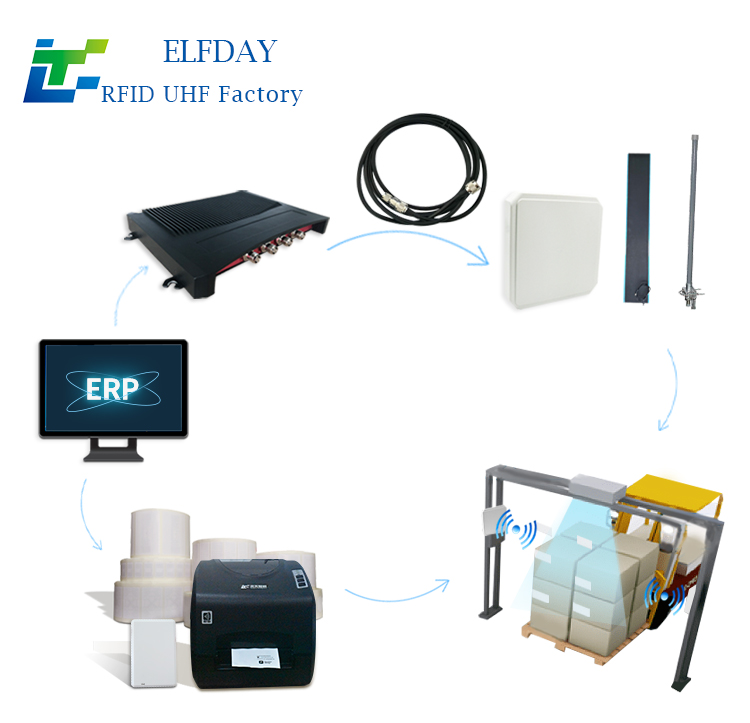
Reader sends signal → tag responds → reader receives data → system processes the information
The communication itself can happen in a very short period.
However, the time required for the complete business process may be longer because the system may also need to:
-
Identify the item
-
Verify the data
-
Send information to software
-
Update an inventory record
-
Confirm the transaction
Therefore, it is useful to distinguish between RFID communication speed and overall workflow speed.
How Fast Can Multiple RFID Tags Be Read?
This is where RFID can provide a major advantage.
Many RFID systems are designed to identify multiple tags in the same reading area.
For example, a warehouse may have a pallet containing dozens of tagged cartons.
Instead of scanning each carton individually, an RFID reader can communicate with the tags within its read zone.
A simplified process is:
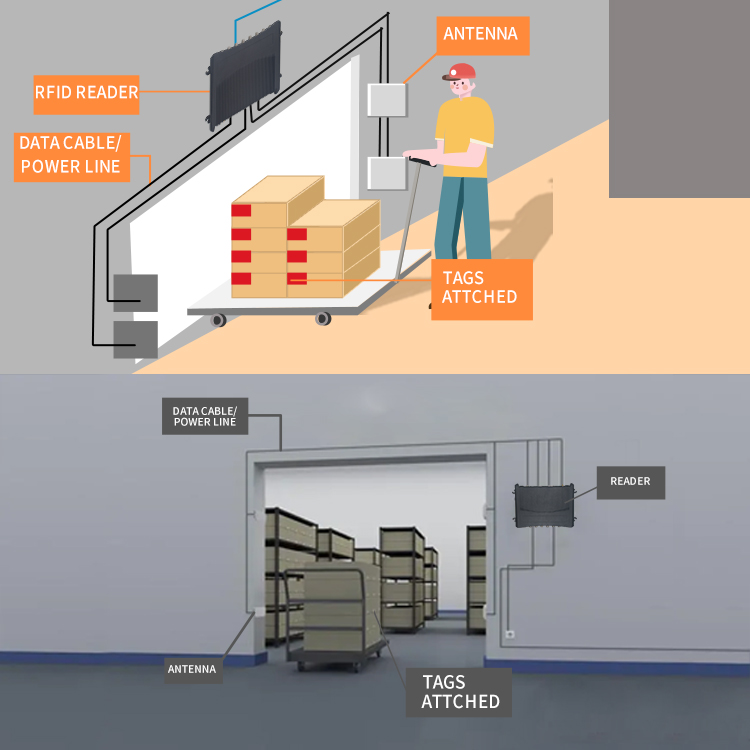
Pallet enters read zone → reader detects tags → tags respond → reader identifies multiple tags → software processes results
The exact time depends on the system and conditions, but the key advantage is that the operator does not necessarily have to handle each item separately.
Can RFID Read Hundreds of Tags Quickly?
Yes, RFID systems can be designed to identify large numbers of tags in a relatively short period.
This is particularly useful in high-volume environments.
Examples include:
-
Warehouse pallets
-
Retail inventory
-
Manufacturing batches
-
Distribution centres
-
Logistics containers
-
Industrial equipment
However, the number of tags alone does not determine performance.
A group of 100 tags placed in an ideal environment may be easier to read than 20 tags packed tightly around metal objects or liquid-filled products.
Why Can RFID Be Faster Than Barcode Scanning?
Barcode scanning generally requires an operator or automated scanner to establish an optical connection with the barcode.
A typical process is:
Find barcode → position scanner → scan → move to next item
RFID can use a different process:
Enter read zone → RFID reader communicates with tags → multiple tags identified
This difference can reduce the amount of physical handling required during some inventory processes.
The benefit is particularly noticeable when employees need to identify many items.
RFID Reading Speed vs. Manual Counting
Manual inventory counting requires employees to physically inspect and record products.
For example:
Employee finds item → counts item → records item → repeats
RFID can automate much of the identification process:
Reader scans area → tags respond → system collects IDs → inventory records are updated
This does not mean RFID automatically eliminates every inventory task, but it can significantly reduce repetitive identification work.
What Is RFID Tag Read Rate?
The term read rate can refer to how quickly an RFID system successfully identifies tags or how many tags it can process over a period of time.
For example, an RFID system may be evaluated based on:
-
Tags identified per second
-
Items processed per minute
-
Percentage of tags successfully detected
-
Time required to complete an inventory cycle
These measurements should not be treated as interchangeable.
A system that reads a large number of tags quickly but misses some tags may be less useful than a slightly slower system that consistently captures the required information.
For real-world RFID applications, read reliability is often just as important as raw speed.
What Is RFID Read Rate vs. Read Range?
These two concepts are different.
Read Rate
How quickly the system can identify and process tags.
Read Range
How far away a tag can be reliably detected.
A system can have a long read range without necessarily having the highest possible tag-processing speed.
Likewise, a fast reader does not automatically provide a long read distance.
Both factors need to be considered when designing an RFID application.
How Does the Number of Tags Affect Reading Speed?
When more tags are present, the reader needs to manage more communication.
RFID protocols use anti-collision techniques to prevent multiple tags from interfering with one another.
For example:
10 tags → relatively small communication workload
100 tags → more tag responses to manage
500 tags → much greater communication and processing requirements
As the tag population increases, system performance can change depending on tag density, reader settings, data requirements, and the physical environment.
What Is Anti-Collision and Why Does It Matter?
Anti-collision technology allows an RFID reader to manage communication with multiple tags.
Without it, multiple tags could respond simultaneously and interfere with each other's signals.
The RFID system instead coordinates tag responses.
A simplified example is:
Reader detects multiple tags → selects or organizes tag responses → tags respond in sequence → reader collects IDs
This makes multi-tag reading possible and is a major reason RFID can be effective for inventory applications.
Does Reading More Data Make RFID Slower?
It can.
A tag that only needs to provide a short identifier generally requires less communication than a tag that needs to transfer a larger amount of stored information.
For example:
Short tag ID → relatively small amount of data
versus
Large user-memory record → more information to transfer
Therefore, RFID system performance can depend not only on how many tags are present but also on how much information the reader needs to obtain from each tag.
Does RFID Frequency Affect Reading Speed?
Yes, different RFID technologies have different communication characteristics.
LF RFID
Low-frequency RFID is generally used for relatively short-range identification applications.
HF RFID
High-frequency RFID operates at 13.56 MHz and is used in applications such as access control, cards, and item identification.
UHF RFID
UHF RFID is commonly used for inventory, logistics, retail, and asset tracking because it supports longer read ranges and efficient multi-tag communication.
The technology selected should match the required application rather than simply choosing the system with the highest theoretical speed.
How Fast Is UHF RFID?
UHF RFID can support high-speed multi-tag identification, which is one reason it is widely used in warehouse, retail, manufacturing, and logistics applications.
A UHF reader can communicate with multiple tags in its operating zone and process their responses using the applicable RFID protocol.
Actual performance varies significantly depending on:
-
Reader hardware
-
Tag population
-
Antenna configuration
-
Reader settings
-
Tag sensitivity
-
Distance
-
Tag orientation
-
Product materials
-
Environmental interference
For this reason, manufacturer specifications should be treated as reference values rather than guarantees of real-world performance.
Can RFID Read Tags While They Are Moving?
Yes, RFID can be used to identify tags while items are moving.
This is particularly useful for:
-
Conveyor systems
-
Warehouse doors
-
Shipping areas
-
Receiving stations
-
Production lines
-
Automated sorting
For example:
Tagged carton moves through reader zone → reader detects tag → system records identification
The faster the item moves, the less time the tag remains within the effective reading zone.
Therefore, fast-moving applications require careful attention to reader placement, antenna coverage, tag orientation, and system configuration.
How Fast Can RFID Read a Moving Pallet?
There is no single speed that applies to every RFID pallet-tracking system.
A pallet moving through a reading area can potentially be identified while in motion, but successful reading depends on:
-
Pallet speed
-
Number of tags
-
Tag location
-
Reader antenna arrangement
-
Tag orientation
-
Materials on the pallet
-
Read-zone size
-
Environmental conditions
The goal is to create enough opportunity for the reader to communicate with all required tags before the pallet leaves the reading zone.
Does Tag Orientation Affect Reading Speed?
Yes.
A poorly oriented tag may require more opportunities to be successfully identified than a well-positioned tag.
For example, a tag facing the reader antenna may communicate efficiently, while a tag positioned at an unfavorable angle may produce a weaker response.
In a moving application, this can become particularly important because the available reading time is limited.
Do Metal and Liquids Slow RFID Reading?
They can affect RFID performance.
Metal
Metal can interfere with standard RFID tag antennas and electromagnetic fields.
Liquids
Liquids can absorb or interact with RF energy, potentially reducing tag response.
These conditions may not simply make RFID “slower.” They can instead reduce the probability of successful reads or make communication less reliable.
For difficult environments, specialized RFID tags may be required.
What Makes RFID Reading Faster?
Several design choices can improve RFID system performance.
Use Suitable Tags
Choose tags designed for the target product and environment.
Optimize Antenna Placement
Reader antennas should create an effective reading zone.
Minimize Unnecessary Data Transfer
If the application only needs an identifier, there may be little reason to read large amounts of user memory.
Control Tag Orientation
Where possible, position tags consistently.
Reduce RF Interference
The surrounding environment should be evaluated for potential sources of interference.
Test With Real Products
Testing with actual inventory, packaging, equipment, and movement conditions is more useful than relying solely on theoretical specifications.
RFID Speed in Different Applications
Retail Inventory
RFID can help employees identify many products during inventory checks without individually scanning every barcode.
Warehouse Receiving
Readers can identify tagged cartons and pallets as they move through receiving areas.
Manufacturing
RFID can track components and work-in-process items moving between production stages.
Logistics
RFID can identify tagged shipments and containers as they pass through designated reading points.
Asset Tracking
Readers can quickly detect tagged tools, equipment, and industrial assets within a defined area.
RFID Reading Speed vs. Reading Accuracy
When evaluating RFID performance, speed should not be the only metric.
Consider two systems:
System A: Reads extremely quickly but occasionally misses tags.
System B: Reads slightly more slowly but consistently captures the required tags.
For inventory management, System B may be more useful.
A successful RFID deployment should therefore consider:
-
Read speed
-
Read accuracy
-
Read range
-
Tag population
-
False reads
-
Missed reads
-
Data processing time
-
Overall workflow efficiency
The best system is usually the one that meets the application's performance requirements reliably.
Frequently Asked Questions
How fast can RFID tags be read?
RFID tags can be read very quickly, and many RFID systems can identify multiple tags within a short period. Actual performance depends on the RFID technology, reader, tag population, distance, orientation, and environment.
Can RFID read multiple tags at the same time?
Yes. Many RFID systems are designed for multi-tag identification. Anti-collision protocols help the reader manage responses from multiple tags.
Is RFID faster than barcode scanning?
For high-volume identification, RFID can be faster because multiple tags can often be detected without individually positioning a scanner in front of each item.
Can RFID read tags while moving?
Yes. RFID can identify moving tags when they pass through a suitable reading zone. The speed of the items, tag placement, antenna design, and environment all affect performance.
Does a higher RFID read speed mean better performance?
Not necessarily. Read accuracy and reliability are also important. A fast system that misses tags may not be suitable for inventory or tracking applications.
What affects RFID reading speed?
Important factors include tag population, reader capabilities, antenna configuration, RFID frequency, tag orientation, distance, data volume, materials, and RF interference.
Can RFID read hundreds of tags quickly?
Yes, appropriately designed RFID systems can identify large tag populations efficiently. Performance depends heavily on tag density, reader configuration, tag design, and the environment.
RFID tags can be read very quickly, and many RFID systems can identify multiple tags during a single reading operation. This gives RFID an important advantage in high-volume applications where manually scanning products one by one would take significant time.
However, there is no universal RFID reading speed. Tag population, reader hardware, RFID frequency, antenna design, tag orientation, distance, data volume, and surrounding materials all affect real-world performance.
For warehouses, retail stores, manufacturing facilities, logistics operations, and industrial environments, the most useful measure is not simply how fast a reader can detect a tag. It is how quickly and reliably the complete RFID system can identify the required items and turn that information into useful operational data.