



How to Plan RFID Tag Placement on Different Types of Assets
RFID technology helps businesses identify and track equipment, tools, containers, inventory, and other assets without requiring direct line-of-sight scanning. However, successful RFID asset tracking depends on more than choosing a suitable tag. Where and how the tag is installed can significantly affect reading reliability, durability, and long-term maintenance.
Different assets present different challenges. Metal equipment may interfere with conventional RFID tags, plastic containers may be stacked in ways that affect antenna coverage, and tools may experience repeated impacts or handling. Cartons and pallets may also require consistent tag positions to support automated inventory and logistics workflows.
Planning RFID tag placement before installation helps businesses reduce avoidable reading problems and build a more reliable tracking system. This guide explains how to approach tag placement across common asset types.
1. Start with the Asset and Tracking Requirements
Before selecting a mounting position, determine what the RFID system needs to identify and how the asset will be used.
A tag placement strategy should account for the asset's physical characteristics, operating environment, handling process, and reading method.
Consider the following questions:
-
What material is the asset made of?
-
Will the tag be mounted directly on metal, plastic, wood, glass, or packaging?
-
Will the asset remain stationary or move through a reading zone?
-
Will it be stacked, stored in racks, transported, or handled frequently?
-
How far away must the reader identify the tag?
-
Will the asset pass through a fixed reader, be scanned with a handheld reader, or be checked at a workstation?
-
Does the tag need to withstand moisture, abrasion, chemicals, temperature changes, or repeated impacts?
-
Must the tag remain accessible for inspection or replacement?
These requirements help determine both the appropriate tag construction and the most practical mounting location.
For example, a stationary machine may allow a fixed, protected tag position. A reusable transport container may need a mounting location that remains visible to readers even when containers are stacked.
2. Plan RFID Tag Placement on Metal Equipment
Metal assets are common in manufacturing, maintenance, construction, and industrial operations. Examples include machinery, metal containers, tool cabinets, equipment housings, and reusable metal racks.
Metal can detune a conventional RFID tag antenna and alter the surrounding RF field. As a result, a tag that performs well on a non-metallic surface may not perform as expected when attached directly to metal.
Choose a suitable tag
For direct mounting on metal, consider an anti-metal RFID tag designed for the intended surface and operating conditions. Available designs vary in size, mounting method, frequency, and environmental resistance, so suitability should be confirmed for the actual application.
Choose a practical mounting location
Look for a relatively flat, accessible area that is unlikely to be struck, scraped, or covered during normal use. Avoid locations where brackets, panels, or other structures may obstruct the intended reading path.
The best position also depends on how the asset is identified. A fixed reader may require the tag to face a particular antenna, while a handheld workflow may benefit from a position that is easy for operators to approach.
Test the installed configuration
Test the tag after mounting it on the actual equipment. Evaluate the intended reader, antenna, distance, and orientation rather than relying only on a tag's performance on a laboratory test surface.
For large or complex machines, test representative locations before standardizing the placement across the entire asset fleet.
3. Plan Tag Placement on Tools and Small Equipment
Hand tools, power tools, maintenance instruments, and portable equipment are frequently moved, stored, checked out, and returned. Their tags must be easy to identify without interfering with normal use.
A practical mounting position should:
-
Avoid handles, grips, control buttons, and moving parts.
-
Reduce exposure to impact, friction, and abrasion.
-
Remain attached during routine cleaning and handling.
-
Avoid interfering with tool operation or safety requirements.
-
Be accessible during handheld or workstation reading.
For metal tools, an appropriately designed anti-metal tag may be required. Small assets also create a space constraint: a tag must fit the available surface while providing suitable performance.
If tools are stored in drawers, cabinets, or tightly packed racks, test the tags in their actual storage arrangement. A position that works well when a tool is isolated may behave differently when several tools are close together.
For high-value or frequently serviced equipment, it may also be useful to choose a placement that allows staff to inspect the tag and confirm its condition without dismantling the asset.
4. Plan Tag Placement on Plastic Containers and Reusable Bins
Plastic containers, totes, trays, and reusable bins are common in warehouses, manufacturing lines, and distribution operations. They are often suitable for conventional RFID tags, but the surrounding contents and handling process still matter.
Choose a consistent location
Where possible, standardize the tag position across containers of the same type. Common options include a side wall, an end panel, or a designated tag holder.
The ideal position depends on how containers move through the system. For example, a conveyor may present one side consistently, while containers handled by forklifts may approach a reader from different directions.
Consider stacking and nesting
Containers may be stacked, nested, or placed closely together. If the tag is hidden between containers or positioned where nearby materials affect the RF field, identification may become less consistent.
Test the container in realistic conditions, including empty and loaded configurations where relevant. Liquid contents, dense materials, and metal components inside a container can change the RF environment.
Account for repeated use
Reusable containers may experience washing, abrasion, impacts, and repeated handling. Choose a tag and attachment method that can withstand these conditions.
If the container design includes a dedicated tag recess or holder, it can help protect the tag and maintain consistent placement across the fleet.
5. Plan Tag Placement on Cartons and Packaged Goods
Cartons and packaged goods are widely used in warehouse inventory, order fulfillment, shipping, and receiving. Tag placement should support the intended reading process without being damaged or obscured during handling.
For many cardboard cartons, a conventional RFID label may be suitable. However, the contents, packaging materials, and surrounding products can influence performance.
Consider these guidelines:
-
Apply labels to a consistent, relatively flat surface.
-
Avoid folds, seams, damaged areas, and locations where labels may peel.
-
Consider whether straps, wrapping, or other labels may cover the tag.
-
Test cartons with their actual contents, especially when they contain liquids or metal items.
-
Align the placement strategy with the reader and antenna positions at receiving, packing, or shipping points.
If cartons are read while passing through a portal or conveyor, test different orientations and realistic spacing. If items can rotate during handling, a single tag position may not provide the same performance in every situation.
The goal is to create a repeatable placement standard that supports the logistics process rather than relying on an idealized reading position.
6. Plan Tag Placement on Pallets and Large Loads
Pallets often contain multiple cartons or items and may pass through fixed reading zones during receiving, storage, and dispatch.
The correct tag placement depends on what the RFID system is intended to identify. It may need to identify the pallet itself, individual cases, or both. These are different tracking requirements and should be designed separately.
Pallet-level identification
If the objective is to identify a reusable pallet or a complete load as one tracked unit, select a mounting position that remains accessible during normal movement and storage.
Consider the pallet material, forklift handling, wrapping, and the position of nearby loads. A tag placed where it is frequently struck or concealed may require more maintenance or deliver less consistent results.

Case-level identification
If individual cartons within a pallet must be identified, each case needs an appropriate tag and the reading system must be designed for the total tag population and arrangement.
Do not assume that identifying a pallet automatically identifies every item loaded onto it. The tracking design should explicitly define whether the required identification level is the pallet, the cases, the individual products, or a combination.
Validate loaded pallets
Test fully loaded pallets rather than empty pallets alone. The contents, wrapping, adjacent loads, and orientation during passage can all affect the actual reading conditions.
7. Plan Tag Placement on Vehicles and Mobile Assets
Vehicles, carts, mobile equipment, and transport assets may move through multiple reading zones or be identified at gates and checkpoints.
For these applications, tag placement should support reliable identification while protecting the tag from weather, vibration, impacts, and routine maintenance.
Before selecting a position, consider:
-
The asset's material and surface geometry
-
Exposure to rain, dust, sunlight, chemicals, or temperature extremes
-
Potential interference from nearby metal structures
-
Reader locations and the expected direction of approach
-
Whether the asset may be read from different angles
-
Maintenance access and replacement requirements
For metal vehicles or mobile equipment, a tag designed for on-metal mounting may be appropriate. However, the best position depends on the tag design, antenna layout, and the intended reading zone.
Test the asset approaching the reader from realistic directions and at the expected operating speed. Confirm that the system identifies the intended asset without regularly reading nearby vehicles or equipment outside the zone.
8. Consider Tag Placement for Different Reading Methods
The reading method affects which mounting locations are practical.
| Reading method | Placement priority | What to test |
| Handheld reader | Easy operator access | Distance, orientation, and handling convenience |
| Fixed workstation | Repeatable presentation | Tag position and antenna alignment |
| Conveyor | Reliable reading during movement | Speed, spacing, and item orientation |
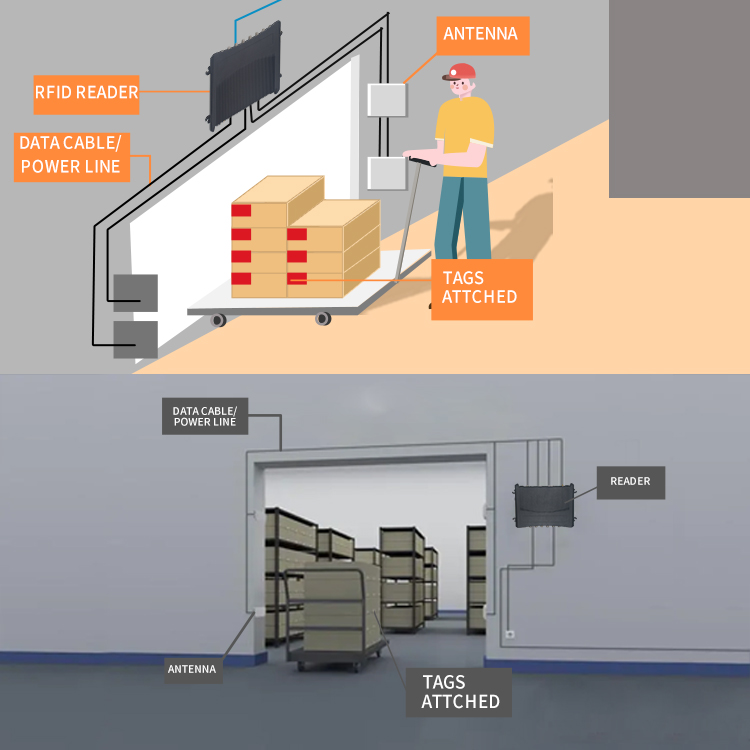
| Portal or gate | Coverage across the passage | Different approach directions and unwanted reads |
| Storage shelves | Coverage across stored assets | Shelf geometry, item density, and neighboring tags |
A position optimized for handheld reading may not be ideal for a fixed portal. Similarly, a tag that is easy to read on a stationary asset may become difficult to identify when the asset moves quickly through a narrow reading zone.
Plan tag placement around the complete workflow, including where the asset enters, exits, or changes status.
9. Standardize Placement Across Similar Assets
Consistency is especially valuable when a business manages hundreds or thousands of assets.
A documented placement standard helps installation teams apply tags correctly and makes future maintenance easier. It also reduces variation between assets that should behave similarly.
A placement standard can include:
-
Asset category and tag model
-
Approved mounting location
-
Tag orientation and mounting method
-
Required surface preparation
-
Reader type and expected reading conditions
-
Inspection and replacement instructions
-
Validation criteria after installation
Where practical, use diagrams or photographs to show the approved position. For complex assets, identify acceptable alternative locations and specify when additional testing is required.
Standardization does not mean every asset must use exactly the same tag. Different materials, sizes, and operating conditions may require different tag designs while still following a consistent installation process.
10. Validate Placement Before Full Deployment
Before rolling out a placement standard across a fleet, test it under realistic conditions.
A pilot should include representative asset types, actual mounting surfaces, the intended readers and antennas, and the normal operating environment.
A useful validation process is:
-
Select representative assets from each category.
-
Install the proposed tags using the intended mounting method.
-
Test the assets at expected distances and orientations.
-
Reproduce normal handling, storage, stacking, or movement.
-
Record expected tags and successfully identified tags.
-
Repeat tests to check consistency.
-
Inspect the tags after normal handling or environmental exposure where relevant.
-
Adjust the placement standard and retest before scaling up.
Useful metrics include identification completeness, time required to identify an asset, unwanted reads, and the physical condition of the tag after use.
A placement that performs well in a controlled test should still be checked under normal operating conditions before it becomes the standard for the entire asset fleet.
Planning RFID tag placement on different types of assets requires more than finding an available surface. Metal equipment, tools, plastic containers, cartons, pallets, and mobile assets each present different challenges related to materials, handling, tag protection, and reading-zone coverage.
The most reliable approach is to define the tracking workflow first, select a tag suited to the asset, choose a practical mounting location, and validate the complete setup using the intended reader and real operating conditions.
By standardizing placement across similar assets and documenting the installation requirements, businesses can reduce avoidable identification problems, simplify maintenance, and build a more dependable RFID asset tracking system.
Planning an RFID asset tracking project? Evaluate asset materials, tag mounting options, reader placement, and operating conditions together before selecting a tag configuration for large-scale deployment.