



UHF RFID vs HF RFID: Which Technology Should You Choose?
When comparing UHF RFID vs HF RFID, the right choice depends on how far tags need to be read, how many items need to be identified, what materials are involved, and how the RFID system will be used.
UHF RFID is generally designed for longer-range identification and high-volume reading. It is commonly used for warehouse inventory, retail stock management, logistics, manufacturing, and asset tracking. HF RFID operates at 13.56 MHz and is often used for short-range identification, access control, library management, ticketing, and NFC-related applications.
Neither technology is suitable for every situation. Understanding the differences between UHF and HF RFID can help you select the right tags, readers, and system architecture for your application.
UHF RFID vs HF RFID: Quick Comparison
| Feature | UHF RFID | HF RFID |
| Frequency | Typically 860–960 MHz | 13.56 MHz |
| Typical read range | Several centimetres to several metres | Usually short range |
| Bulk reading | Highly suitable | Possible in suitable systems |
| Reading speed | High | Moderate to high depending on system |
| Smartphone compatibility | Generally requires dedicated equipment | Compatible with many NFC-enabled devices |
| Common applications | Warehouses, logistics, retail, asset tracking | Libraries, access control, tickets, NFC |
| Metal performance | Special tag designs may be required | Special tag designs may be required |
| Liquid performance | Requires careful tag placement and design | Application-dependent |
| Best suited for | Long-range and automated tracking | Short-range and controlled interaction |
Actual read range and performance vary according to tag design, reader power, antenna configuration, mounting surface, environment, and local regulations.
What Is UHF RFID?
UHF RFID stands for Ultra High Frequency Radio Frequency Identification.
UHF RFID systems commonly operate in the 860–960 MHz range, although the exact frequency allocation depends on regional regulations.
UHF RFID is particularly useful when an organization needs to identify products or assets without requiring an operator to position each individual tag directly in front of a reader.
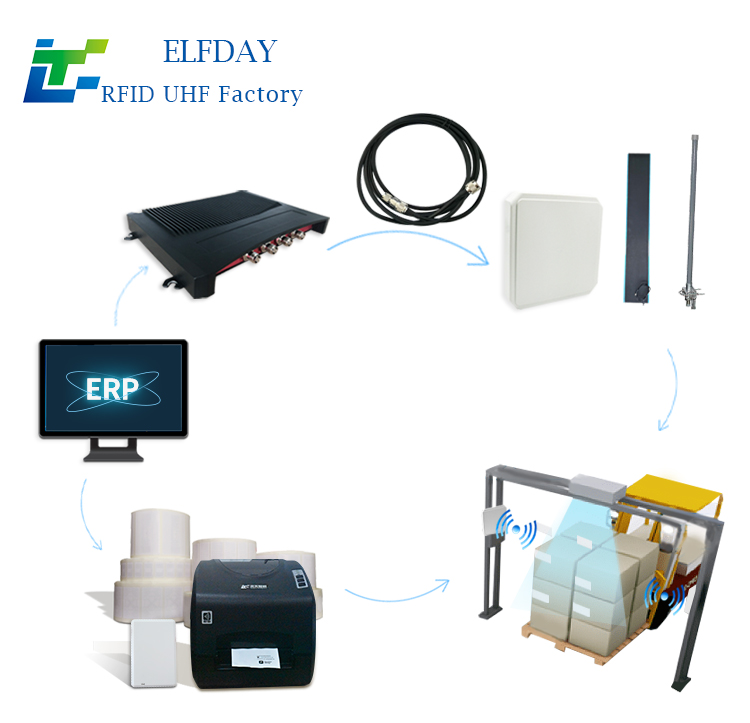
A typical UHF RFID system includes:
-
UHF RFID tags
-
Fixed or handheld RFID readers
-
RFID antennas
-
RFID middleware or software
-
Inventory or asset management systems
Most passive UHF RFID tags do not contain batteries. Instead, the RFID reader sends radio energy toward the tag. The tag uses this energy to respond with its stored identification information.
This makes UHF RFID useful for automated identification across warehouses, retail stores, manufacturing facilities, and logistics operations.
Common UHF RFID Applications
UHF RFID is frequently used for:
-
Warehouse inventory tracking
-
Retail inventory management
-
Pallet tracking
-
Carton tracking
-
Shipping and receiving
-
Manufacturing processes
-
Asset tracking
-
Tool management
-
Equipment identification
-
Laundry and textile tracking
-
Supply chain visibility
One of the biggest advantages of UHF RFID is the ability to identify multiple tags quickly.
What Is HF RFID?
HF RFID stands for High Frequency Radio Frequency Identification.
HF RFID operates at 13.56 MHz and is commonly used for applications where the tag and reader are relatively close to each other.
Unlike many UHF applications that are designed around long-range identification, HF RFID is often used for controlled interactions. A person may present a card, tap a tag, place a book near a reader, or bring a product close to a scanning point.
HF RFID is also closely associated with NFC technology, which operates at the same 13.56 MHz frequency.
Common HF RFID Applications
HF RFID can be used for:
-
Library management
-
Access control
-
Contactless cards
-
Event tickets
-
Transportation cards
-
Document identification
-
Product authentication
-
Smart packaging
-
Healthcare identification
-
NFC-based product interaction
Its short-range characteristics can be useful when the system is designed around intentional tag-reader interaction.
What Is the Main Difference Between UHF RFID and HF RFID?
The biggest difference between UHF RFID and HF RFID is the way they are designed to communicate and the operating conditions where they are most useful.
UHF RFID generally supports longer-range identification and high-volume tag reading. HF RFID is more commonly used for short-range communication and controlled interactions.
The main differences include:
-
Operating frequency
-
Read distance
-
Bulk reading capability
-
Smartphone compatibility
-
Application type
-
Tag and antenna design
-
Performance around different materials
-
System architecture
The important point is that frequency alone should not determine your choice. The complete application needs to be considered.
UHF RFID vs HF RFID: Read Range
Read range is one of the most important differences between these two technologies.
UHF RFID Read Range
UHF RFID can often achieve read distances of several metres with an appropriately designed system.
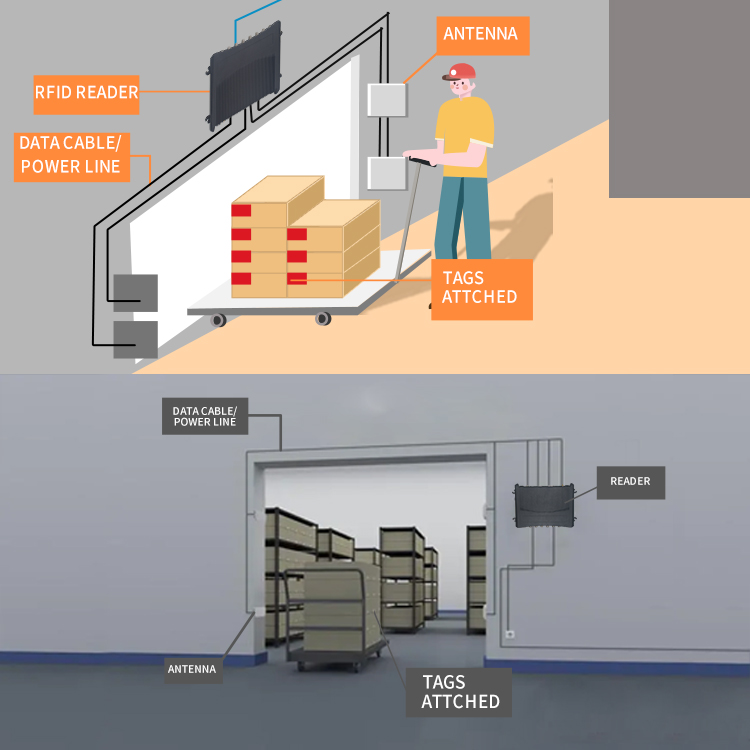
For example, a fixed UHF RFID reader may identify tagged cartons as they move through a warehouse entrance. A handheld UHF reader can also scan multiple products on a shelf without requiring each tag to be individually presented to the reader.
The actual range depends on:
-
Reader power
-
Antenna gain and configuration
-
Tag antenna design
-
Tag size
-
Tag orientation
-
Mounting surface
-
Environmental interference
-
Regulatory requirements
Larger tags with appropriately designed antennas may provide better read performance than very small tags, although tag size is only one part of the overall system.
HF RFID Read Range
HF RFID normally operates at a much shorter distance.
Many HF applications require the tag to be placed close to the reader. This is particularly useful for applications such as access cards, library books, tickets, and NFC interactions.
Some HF systems can achieve longer ranges than basic tap-style applications, but HF is generally not selected when the primary requirement is multi-metre inventory reading.
Which Has the Longer Read Range?
In general, UHF RFID provides a longer read range than HF RFID.
If your workflow requires tags to be identified from several metres away, UHF RFID is usually the technology to investigate first.
If the user intentionally brings the tag close to the reader, HF RFID may provide a better fit.
Which RFID Technology Is Faster?
Both technologies can support fast identification, but they are commonly used in different ways.
UHF RFID is particularly well suited to high-speed inventory operations where many tags need to be identified in a short period.
For example, a warehouse employee may walk along a storage aisle with a handheld UHF reader and identify multiple tagged items without scanning each item separately.
A fixed reader can also identify tagged products or containers as they move through a defined reading area.
HF RFID can also support fast reading, particularly in systems designed for multiple-tag identification. However, many HF applications involve a controlled interaction between one tag and a reader.
UHF RFID Is Often Used For:
-
Bulk inventory counting
-
Pallet identification
-
Carton tracking
-
Warehouse receiving
-
Shipping verification
-
Retail stock checks
HF RFID Is Often Used For:
-
Card authentication
-
Library check-in and check-out
-
Ticket validation
-
Access control
-
Short-range product interaction
Therefore, if your priority is high-volume automated identification, UHF RFID may be more appropriate.
UHF RFID vs HF RFID and Smartphones
Smartphone compatibility is another important difference.
Many modern smartphones support NFC, which operates at 13.56 MHz. This means compatible HF RFID and NFC tags can sometimes be read using a smartphone.
This makes HF technology useful for applications such as:
-
Digital product information
-
Smart packaging
-
Product authentication
-
Customer engagement
-
Digital business cards
-
Contactless interaction
UHF RFID tags generally cannot be read directly by a standard smartphone.
A dedicated UHF RFID reader is normally required, although external accessories can provide additional RFID capabilities for certain devices.
Choose HF RFID When Smartphone Interaction Matters
If customers, employees, or operators need to tap a smartphone against a tag, HF/NFC technology may be worth considering.
For example, a product could contain an NFC-compatible tag that allows a customer to access product information by bringing their phone close to the tag.
By contrast, a warehouse inventory system typically uses dedicated UHF RFID handheld readers or fixed readers.
UHF RFID vs HF RFID on Metal
Metal can create challenges for RFID systems.
A metal surface can reflect radio energy and affect the performance of the tag antenna. As a result, a standard RFID label that works well on cardboard may not work properly when attached directly to steel or aluminum.
UHF RFID on Metal
For UHF RFID, specialized on-metal RFID tags are commonly used for:
-
Machinery
-
Tools
-
Steel containers
-
Equipment
-
Vehicles
-
Industrial assets
-
Metal racks
These tags may use spacers, specialized antenna structures, or protective housings to maintain suitable RF performance.
HF RFID on Metal
HF RFID can also require special consideration when mounted on metal.
Depending on the application, the tag may require a suitable construction or spacing layer between the antenna and the metal surface.
The key lesson is simple:
Always test the RFID tag on the actual material where it will be installed.
Do not assume that an RFID tag designed for plastic or cardboard will perform equally well on metal.
UHF RFID vs HF RFID for Liquid Products
Liquids can also affect RFID performance.
Water-rich materials can absorb or interact with radio-frequency energy, which can reduce read range or create inconsistent results.
This can be important when tagging:
-
Bottled beverages
-
Cosmetics
-
Cleaning products
-
Pharmaceutical liquids
-
Food containers
-
Chemical containers
UHF RFID can still be used on liquid products, but tag placement becomes particularly important.
For example, the tag may perform better when positioned on an area of the package where the antenna is less affected by the liquid.
HF RFID can also be affected by the surrounding material. Shorter reading distances may make some applications easier to control, but the complete tag and product combination should still be tested.
UHF RFID vs HF RFID for Warehouse Inventory
For warehouse inventory, UHF RFID is often a natural fit.
A warehouse may contain thousands of tagged products, cartons, pallets, or containers. Manually scanning each barcode individually can require significant operator movement.
A UHF RFID system can potentially identify multiple tags within the reader's operating area.
This can support:
-
Faster stock counts
-
Receiving verification
-
Shipping verification
-
Inventory visibility
-
Shelf checks
-
Pallet tracking
-
Location monitoring
HF RFID can also be used for inventory-related applications, particularly where items are intentionally presented to a reader. However, it is generally less suited to large-scale, long-range warehouse scanning.
UHF RFID vs HF RFID for Retail
Retail applications can require both technologies depending on the objective.
UHF RFID for Retail Inventory
UHF RFID can be used to track individual products throughout a retail environment.
Examples include:
-
Apparel
-
Shoes
-
Accessories
-
Electronics
-
General merchandise
Retail staff can use handheld UHF readers to perform inventory checks and identify products that may need replenishment.
HF RFID for Customer Interaction
HF RFID and NFC can be useful when the tag is intended to interact directly with a customer.
For example, an NFC-compatible tag could provide:
-
Product information
-
Digital instructions
-
Authentication
-
Promotional content
-
After-sales information
This creates an important distinction:
UHF RFID is often used for operational tracking, while HF/NFC can be useful for direct short-range interaction.
UHF RFID vs HF RFID for Asset Tracking
Both technologies can be used for asset tracking, but the ideal choice depends on the asset and workflow.
UHF RFID for Large-Scale Asset Tracking
UHF RFID can be useful when assets need to be identified across a large facility.
Examples include:
-
Industrial equipment
-
Tools
-
Containers
-
Pallets
-
Returnable transport items
-
Warehouse assets
A handheld reader can be used to locate assets, while fixed readers can monitor movement through specific areas.
HF RFID for Controlled Asset Identification
HF RFID may be suitable when the asset is intentionally presented to a reader.
For example, an organization may use HF RFID to identify documents, access cards, library materials, or smaller assets at a controlled reading station.
UHF RFID vs HF RFID for Access Control
HF RFID is commonly associated with access control applications.
An employee may present a card or credential near a reader installed at a door.
This short-range interaction can help create a controlled identification point.
UHF RFID can also be used in access-related systems, but its longer read range can make the system architecture more complex when precise, intentional presentation is required.
For applications where the user is expected to intentionally tap or present a credential, HF RFID is often worth evaluating.
UHF RFID vs HF RFID: Cost
The cost of an RFID system depends on more than the price of the tag.
Consider the total system cost, including:
-
RFID tags
-
Readers
-
Antennas
-
Handheld devices
-
Software
-
Integration
-
Installation
-
Maintenance
-
Testing
-
Training
-
Tag replacement
UHF RFID systems used for warehouses may require fixed readers, multiple antennas, handheld equipment, and software integration.
HF RFID systems may have a simpler architecture for applications such as access control or short-range identification.
However, the cheapest tag is not necessarily the most cost-effective choice.
A tag that fails to read correctly can result in:
-
Repeated scanning
-
Manual work
-
Inventory errors
-
Tag replacement
-
Workflow delays
The better approach is to compare total operating cost, not just the initial tag price.
How to Choose Between UHF RFID and HF RFID
A simple decision process can help.
Choose UHF RFID If You Need:
-
Longer read distances
-
Multi-item identification
-
Fast inventory counting
-
Warehouse tracking
-
Logistics tracking
-
Pallet or carton identification
-
Automated movement monitoring
-
Large-area asset tracking
-
Handheld RFID inventory scanning
Choose HF RFID If You Need:
-
Short-range identification
-
Controlled tag-reader interaction
-
Smartphone or NFC compatibility
-
Access cards
-
Library management
-
Ticketing
-
Contactless interaction
-
Product authentication
-
Short-range product experiences
What Should You Test Before Choosing?
Before deploying either technology, test the RFID system under actual operating conditions.
1. Test the Real Product
Do not test only the bare RFID tag.
Attach the tag to the actual product, container, asset, or packaging.
2. Test the Final Tag Position
Changing the tag location can significantly affect performance.
This is especially important for:
-
Metal products
-
Liquid-filled products
-
Small packages
-
Curved surfaces
-
Dense packaging
3. Test Different Orientations
RFID tag orientation can affect read performance.
Test the tag from different angles if the item can move or rotate during normal operations.
4. Test at the Required Distance
If the application requires a 3-metre reading distance, test at that distance.
Do not assume that a successful 30-centimetre test means the system will work at several metres.
5. Test the Full Environment
Consider:
-
Metal shelving
-
Nearby machinery
-
Liquids
-
Other RF devices
-
Temperature
-
Moisture
-
Human movement
-
Packaging density
Real-world testing is one of the most effective ways to identify RFID performance issues before deployment.
Can UHF RFID and HF RFID Be Used Together?
Yes.
Some applications can benefit from using both technologies because they solve different problems.
For example, a supply chain system could use UHF RFID for warehouse inventory while using HF or NFC for customer-facing product interaction.
A product could therefore have:
UHF RFID → warehouse and logistics tracking
HF/NFC → smartphone interaction and product information
Another example could be an industrial facility where UHF RFID tracks equipment movement while HF RFID provides a controlled maintenance or identification point.
Using two RFID technologies increases system complexity, so it should only be considered when each technology provides a useful function.
Common Mistakes When Choosing RFID Technology
Mistake 1: Choosing Based Only on Read Range
Longer range is not always better.
A controlled access system may actually benefit from short-range identification.
Mistake 2: Ignoring the Product Material
Metal, liquids, glass, plastic, and other materials can influence RFID performance.
Mistake 3: Testing the Tag Separately
The final product and tag should be tested together.
Mistake 4: Assuming All UHF Tags Perform the Same
Different UHF RFID tags can have significantly different antenna designs, sizes, materials, and read characteristics.
Mistake 5: Ignoring Tag Orientation
The orientation between the tag and reader antenna can affect performance.
Mistake 6: Looking Only at Tag Price
System reliability and operating efficiency can be more important than the initial tag cost.
Frequently Asked Questions
Is UHF RFID better than HF RFID?
Neither technology is universally better. UHF RFID is generally more suitable for longer-range, high-volume tracking, while HF RFID is commonly used for short-range identification and controlled interactions.
Which has a longer RFID read range, UHF or HF?
UHF RFID generally provides a longer read range than HF RFID. Actual performance depends on the reader, antenna, tag, orientation, materials, and environment.
Can a smartphone read UHF RFID?
Most standard smartphones cannot directly read UHF RFID tags. A dedicated or external UHF RFID reader is generally required.
Can a smartphone read HF RFID?
Many smartphones support NFC, which operates at 13.56 MHz. Compatible HF/NFC tags can therefore be used with supported smartphone applications.
Is UHF RFID suitable for warehouse inventory?
Yes. UHF RFID is commonly suited to warehouse inventory because it can support longer-range and multi-tag identification.
Is HF RFID suitable for inventory tracking?
Yes. HF RFID can be used for inventory applications, particularly where tags are intentionally presented to readers or where short-range identification is sufficient.
Which RFID technology is better for metal?
Neither frequency automatically solves metal-related problems. The tag must be specifically designed or positioned for the metal surface. On-metal UHF and HF tags are available for different applications.
Which RFID technology is better for liquid products?
Both can be used, but liquids can affect RFID performance. The tag design, placement, product packaging, and reader configuration should be tested together.
Is HF RFID the same as NFC?
HF RFID and NFC are closely related technologies operating at 13.56 MHz, but they should not be treated as completely interchangeable. NFC is a specific set of communication standards and use cases within the broader HF RFID ecosystem.
The choice between UHF RFID vs HF RFID should start with the application rather than the frequency.
Choose UHF RFID when you need longer-range reading, fast inventory checks, bulk identification, warehouse automation, logistics tracking, or large-scale asset management.
Choose HF RFID when you need short-range identification, controlled interactions, access control, library management, ticketing, or smartphone-compatible NFC experiences.
The most important factors to evaluate are:
-
Required read range
-
Number of tags
-
Reading speed
-
Tag orientation
-
Product material
-
Metal or liquid exposure
-
Smartphone compatibility
-
Environmental conditions
-
Security requirements
-
Total system cost
If you are unsure which technology fits your application, test both the RFID tag and reader with the actual product, mounting position, and operating environment. Real-world testing provides a much more reliable basis for selection than comparing specifications alone.